
As NDIS organisations grow, financial management becomes significantly more complex. While smaller providers may focus on managing a limited number of participants and employees, larger organisations often operate across multiple locations, employ substantial workforces, manage diverse service offerings, and handle significant funding volumes.
Growth brings opportunity, but it also introduces unique accounting challenges that require specialised systems, processes, and oversight. Financial decisions become more impactful, reporting requirements become more demanding, and maintaining consistency across the organisation becomes increasingly difficult.
Unlike small businesses, large NDIS providers must balance operational efficiency with financial accountability while ensuring participant outcomes remain at the centre of every decision. As the scale of operations increases, organisations must strengthen their financial management practices to maintain compliance, visibility, and sustainability.
This article explores the unique accounting challenges faced by large NDIS organisations and the strategies that can help them maintain financial control while continuing to grow.
The financial requirements of a large NDIS organisation differ significantly from those of a smaller provider.
As organisations expand, they often encounter:
What once worked effectively for a small team may no longer be suitable when managing hundreds of participants, multiple departments, and a growing workforce.
Scale requires a different approach to financial management—one focused on structure, consistency, and visibility.
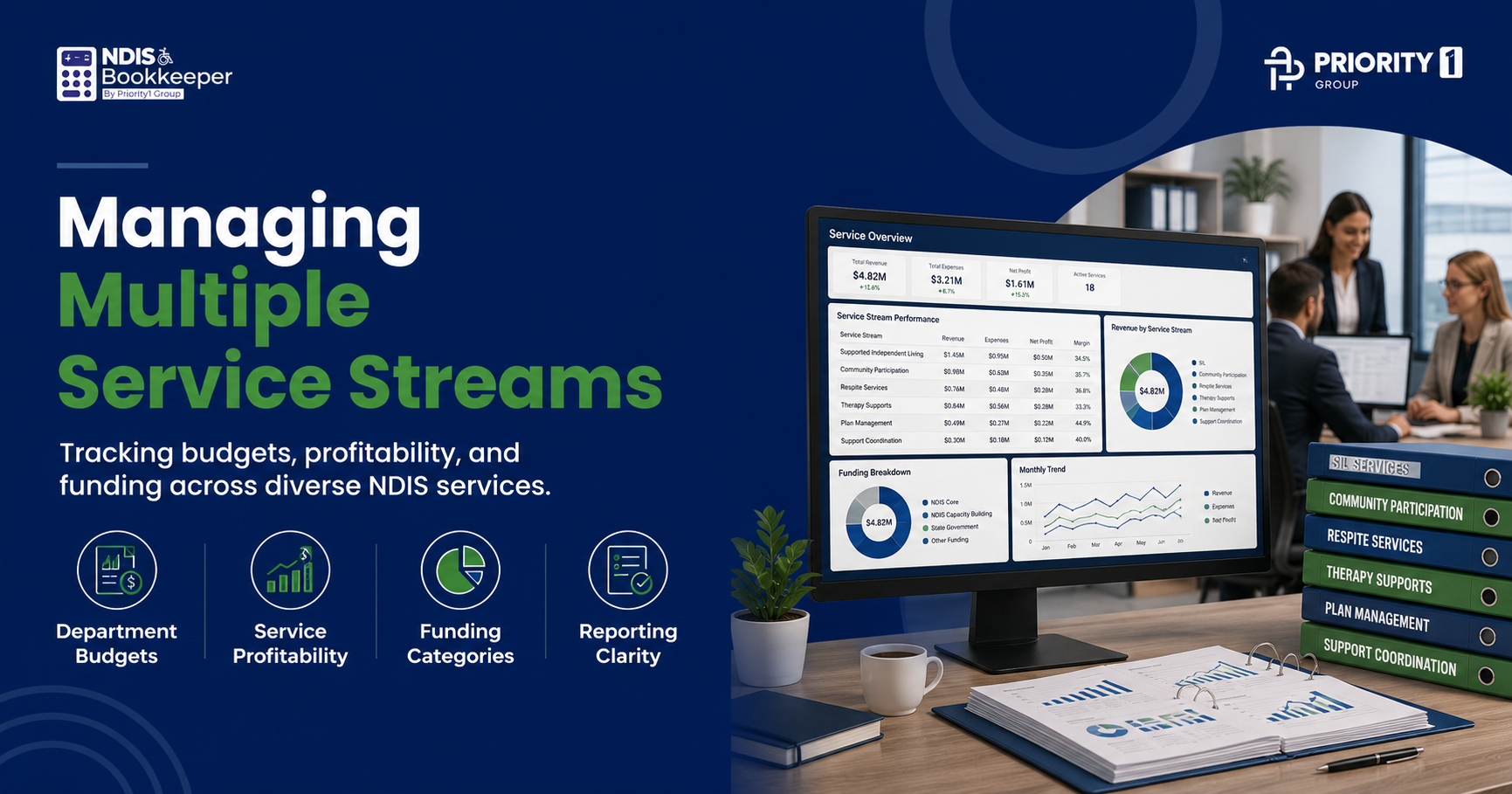
Large providers frequently deliver a wide range of supports, including accommodation services, community participation, transport assistance, nursing supports, and daily living assistance.
Each service area may operate differently from a financial perspective.
Challenges often include:
Without clear financial segmentation, organisations may struggle to understand which services are performing well and where improvements are needed. As operational complexity increases, many organisations choose to outsource NDIS bookkeepers to help maintain accurate reporting, improve financial oversight, and support informed decision-making across multiple service divisions.
Accurate financial reporting becomes increasingly important as service complexity grows.
Payroll often represents one of the largest expenses within an NDIS organisation.
For larger providers, workforce management can involve:
Even small payroll errors can have significant financial consequences when applied across a large workforce.
Organisations seeking to reduce payroll risks can benefit from understanding common issues highlighted in The Payroll Mistakes That Cost Businesses Time & Money.
Strong payroll controls help maintain employee confidence while reducing compliance risks.
Many large NDIS organisations operate across multiple regions or service locations.
While growth creates opportunities to support more participants, it can also create inconsistencies in financial processes.
Different locations may develop different approaches to:
Without standardised systems, these variations can reduce reporting accuracy and create operational inefficiencies.
Successful organisations establish consistent financial procedures that can be applied across all locations while still allowing flexibility where necessary.
Growth is often viewed as a positive indicator of organisational success. However, expansion without financial discipline can create significant challenges.
Large organisations must carefully manage:
Financial growth should support organisational sustainability rather than create unnecessary pressure.
Many providers face the challenge of balancing participant outcomes with financial performance. Our article on NDIS Accounting: Balancing Service Delivery & Financial Health explores how organisations can maintain this balance while supporting long-term success.
Growth should be measured not only by participant numbers but also by operational stability and financial health.
Large organisations require more detailed reporting than smaller providers.
Management teams often need visibility across multiple areas of the business, including:
Departmental reporting allows leaders to identify trends, monitor performance, and make informed decisions.
Without detailed reporting, organisations may struggle to identify areas of concern before they become significant financial issues.
The ability to drill into specific financial data becomes increasingly valuable as organisations expand.
As financial activity increases, so does the importance of internal controls.
Strong controls help protect organisational resources while reducing the risk of errors and fraud.
Examples include:
Internal controls create accountability and help ensure financial information remains accurate and reliable.
Organisations with strong governance structures are often better positioned to manage growth effectively.
Growth naturally results in more financial transactions.
Larger providers may process:
Managing this volume of information manually becomes increasingly difficult.
Technology plays an important role in helping organisations organise, process, and analyse financial data efficiently.
The challenge is not simply collecting information but transforming it into meaningful insights that support decision-making.
Executive teams need access to reliable financial information to guide strategic planning and organisational development.
Large providers benefit from financial visibility that helps answer questions such as:
Clear visibility allows leaders to make proactive decisions rather than reacting to problems after they occur.
Organisations that invest in financial visibility often improve both operational performance and long-term planning.
Large organisations often require specialist expertise to manage increasingly complex financial environments.
Many providers find that working with an Outsourced bookkeeper provides additional support for reporting, process improvement, financial oversight, and operational consistency.
Specialist expertise can help organisations:
As complexity increases, access to experienced financial professionals becomes increasingly valuable.
Technology and financial systems must evolve alongside organisational growth.
Large providers often require systems capable of handling:
Scalable systems help organisations maintain efficiency without creating additional administrative burdens.
Financial infrastructure should support growth rather than limit it.
Organisations that invest in scalable systems are often better positioned to manage future expansion successfully.
Large NDIS organisations operate in a constantly changing environment. Funding arrangements, workforce challenges, participant needs, and regulatory requirements continue to evolve.
Long-term success requires more than compliance and reporting.
It requires:
Organisations that proactively address financial challenges are more likely to achieve sustainable growth while maintaining quality participant outcomes.
This forward-thinking approach allows providers to remain resilient even as the operating environment becomes increasingly complex.
As organisations grow, financial management becomes a shared responsibility across leadership, operations, finance, and service delivery teams.
Effective bookkeeping for NDIS organisations supports stronger reporting, improved visibility, and better decision-making across all levels of the business.
At the same time, many growing providers choose to outsource their NDIS bookkeepers to access specialised expertise, strengthen internal processes, and support increasingly complex financial operations.
When combined with strong systems and governance structures, these approaches help organisations maintain control while continuing to expand.
Large NDIS organisations face unique accounting challenges that extend far beyond basic bookkeeping and reporting. Managing multiple service streams, large workforces, complex funding arrangements, and growing compliance obligations requires a structured and strategic approach to financial management.
Providers that invest in strong systems, detailed reporting, effective governance, and experienced financial support are better positioned to maintain financial stability while delivering quality participant outcomes.
As organisations continue to grow, financial management becomes a critical component of long-term success. By addressing these challenges proactively, providers can create stronger foundations for sustainable growth and operational excellence.
For organisations seeking specialised support tailored to the disability sector, NDIS Bookkeeper by Priority1 Group provides professional financial management solutions designed to support large and growing NDIS providers.