

Running a successful NDIS organisation requires more than delivering quality support services. Providers must also manage complex financial systems, maintain compliance, handle payroll obligations, monitor participant budgets, and ensure long-term business sustainability.
For many providers, balancing participant care with financial management can become one of the biggest operational challenges. While the primary focus is naturally on improving participant outcomes, financial health remains equally important. Without stable financial systems, even high-quality service providers may struggle with cash flow issues, payroll delays, claim rejections, compliance risks, and operational inefficiencies.
The NDIS sector continues to evolve rapidly, placing increasing pressure on providers to improve transparency, accountability, and operational performance. Strong accounting practices are now essential for organisations that want to grow sustainably while maintaining service quality.
This article explores how NDIS providers can balance service delivery with financial health and why strong accounting systems are critical for long-term success.
NDIS providers operate within a highly regulated environment where financial accuracy directly affects both participants and organisational sustainability.
Financial management in the disability sector goes beyond tracking revenue and expenses. Providers must manage:
When financial systems are poorly managed, the impact is often felt across the organisation. Delayed invoicing may disrupt cash flow, payroll errors can affect staff morale, and compliance gaps may increase audit risks.
At the same time, providers must continue delivering compassionate, participant-focused care. This balancing act requires structured systems, operational visibility, and ongoing financial oversight.
Many providers view accounting and participant care as separate functions. In reality, they are closely connected.
Strong financial systems help providers:
When organisations experience financial instability, participant services are often affected indirectly. Staff shortages, scheduling disruptions, delayed supplier payments, or administrative errors can all impact the participant experience.
Reliable accounting systems help providers maintain consistency and improve overall service quality.
This is one reason many organisations now invest more heavily in financial visibility and operational reporting.
The NDIS landscape presents several ongoing financial challenges for providers, particularly those managing growth or operating across multiple regions.
Some of the most common challenges include:
Payroll is often the largest operational expense within disability services. Managing SCHADS Award obligations, overtime, travel allowances, and superannuation requires close attention to detail.
Claim processing issues or delayed invoicing can quickly disrupt business operations.
Providers must maintain detailed financial records, participant documentation, and payroll evidence to remain audit-ready.
As participant numbers grow, financial processes often become more difficult to manage manually.
Many providers struggle with disconnected systems across payroll, rostering, invoicing, and reporting platforms.
Without structured accounting systems, these challenges can create ongoing operational pressure.
One of the most important steps providers can take is improving financial visibility across departments.
Financial visibility means leadership teams can clearly understand:
Without accurate reporting, providers may make decisions based on assumptions rather than reliable financial data.
Improved visibility allows organisations to identify operational issues early and make informed decisions about staffing, expansion, participant capacity, and service delivery.
Many providers now use structured reporting frameworks to strengthen operational planning and accountability.
Providers seeking to improve reporting accuracy and operational oversight may benefit from resources such as Key Metrics Every NDIS Provider Should Track, which highlights important financial indicators that support long-term sustainability.
Balancing service delivery and financial health requires strong operational systems behind the scenes.
Providers should focus on improving processes across:
Timesheet Management- Accurate timesheets are essential for payroll, invoicing, and claims processing.
Documentation Standards- Incomplete participant records may create compliance and billing issues later.
Invoice Processing- Delays in invoicing often lead to unnecessary cash flow pressure.
Payroll Accuracy- Correct award interpretation and payroll management reduce financial risk.
Claims Reconciliation- Regular reconciliation helps identify rejected or missing claims early.
Strong processes reduce operational confusion and create more stability across the organisation.
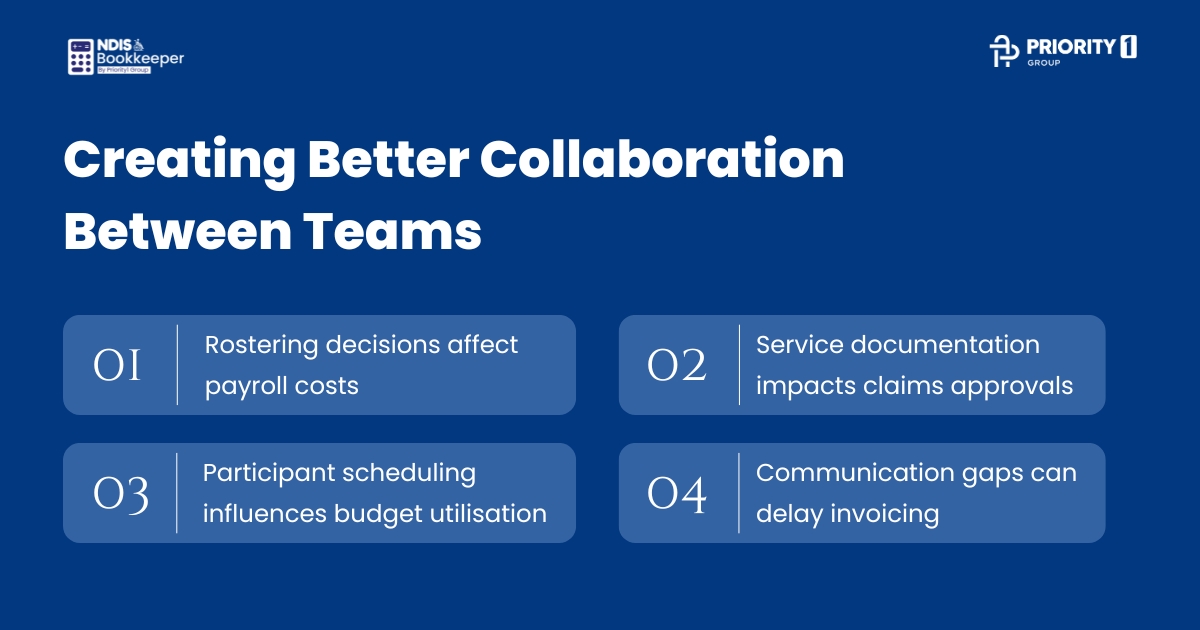
Financial management should not sit solely within the finance department.
Operations teams, support coordinators, administrators, and leadership staff all contribute to financial outcomes through their daily responsibilities.
For example:
Improving collaboration between departments helps providers reduce errors and improve operational consistency.
Organisations with stronger internal collaboration often experience fewer financial disruptions and improved operational efficiency.
As providers grow, financial complexity increases significantly.
More participants, additional staff, multiple service locations, and expanded support offerings create greater pressure on internal systems.
Scalable accounting systems help providers:
Many growing providers also seek external expertise to support these processes.
Working with specialists such as Outsourced Bookkeeper can help organisations streamline financial operations and improve visibility while internal teams remain focused on participant support and service delivery.
In many cases, providers also rely on experienced professionals specialising in bookkeeping for NDIS operations to strengthen reporting accuracy and reduce administrative pressure.
Compliance remains one of the most important aspects of NDIS accounting.
Providers must maintain accurate records across:
As organisations grow, maintaining compliance can become increasingly difficult without structured systems and experienced oversight.
Providers should regularly review:
Internal Financial Processes- Routine reviews help identify weaknesses before they become major issues.
Documentation Standards- Consistent recordkeeping improves audit readiness.
Reporting Accuracy- Reliable reporting supports both compliance and decision-making.
Staff Training- Teams should understand their role in maintaining financial accuracy.
As organisations grow, many providers also reassess their financial management structure to improve visibility and operational efficiency. Resources like Fractional CFOs vs Outsourced Bookkeepers: What’s the Difference? can help providers understand which financial support model best aligns with their operational and compliance needs.
One of the biggest misconceptions within the NDIS sector is that strong financial management somehow conflicts with participant-centred care.
In reality, financially stable organisations are often better positioned to deliver consistent, high-quality support.
Financial strength allows providers to:
This balance requires leadership teams to approach accounting not simply as an administrative requirement, but as a core operational strategy.
Reliable systems, accurate reporting, and experienced financial oversight all contribute to stronger participant outcomes over time.
Many organisations now work closely with a specialised bookkeeper NDIS professional to improve financial structure while supporting sustainable growth.
Balancing service delivery and financial health is one of the most important responsibilities facing NDIS providers today. Delivering quality participant care requires strong financial systems operating behind the scenes.
From payroll and invoicing to reporting, compliance, and operational planning, every financial process contributes to the long-term stability of the organisation.
Providers that invest in structured accounting systems, cross-department collaboration, and operational visibility are often better prepared to manage growth, reduce financial risk, and improve participant outcomes.
As the NDIS sector continues evolving, organisations with strong financial foundations will be better positioned to remain compliant, sustainable, and participant-focused.
Partnering with NDIS Bookkeeper by Priority1 Group can help providers strengthen accounting processes, improve operational efficiency, and build a more stable financial future while continuing to deliver high-quality disability support services.