Running an NDIS business today is very different from managing a simple service-based business. Providers are not only sending invoices and paying bills. They are managing participant supports, staff wages, rosters, service agreements, claiming rules, pricing updates, cash flow, records, and compliance expectations.
Many small and growing NDIS providers begin with a basic bookkeeping setup because it feels manageable at first. There may be fewer participants, fewer staff, and fewer financial tasks to track. But as the business grows, the pressure changes. More services mean more invoices. More staff mean more payroll records. More participants mean more documentation. More pricing updates mean more checks before claims are submitted.
This is where many providers begin to feel stretched. The business may be supporting participants well, but the financial side may start feeling unclear. Reports may not tell the full story. Claims may need more review. Payroll may take longer than expected. Cash flow may feel harder to predict. These are not always signs of poor management. Often, they show that the provider needs more than basic bookkeeping.
At first, bookkeeping may feel like a task that can be handled whenever there is time. Invoices are sent, bank transactions are checked, receipts are saved, and payroll is processed. But in an NDIS business, these tasks are connected to service delivery and compliance.
An invoice may relate to a participant, a support item, a service date, a staff shift, a rate, and a payment record. Payroll may need to match rosters, timesheets, allowances, hours worked, and service delivery information. Reports are not just numbers. They help the provider understand whether the business is stable, whether costs are increasing, and whether cash flow is under control.
When providers are busy, financial tasks can become reactive. The team may only review unpaid invoices when cash flow feels tight. Records may only be checked when the accountant asks. Reports may only be prepared at the end of the month, when it is too late to fix problems early.
Basic record-keeping can show what money came in and what money went out. That is important, but it may not explain why cash flow feels tight, why payroll is increasing, why claims are delayed, or why reports are not matching expectations.
NDIS providers need financial information that supports real decisions. A business owner may need to know whether staff costs are growing faster than income. A manager may need to understand whether delayed invoicing is affecting cash flow. An admin team may need to know whether claims have been checked against the latest pricing information.
Without this clarity, providers may continue operating with blind spots. The business can look busy and still feel financially uncertain. Better bookkeeping helps close these gaps by giving providers a clearer view of the business and helping them identify issues earlier.
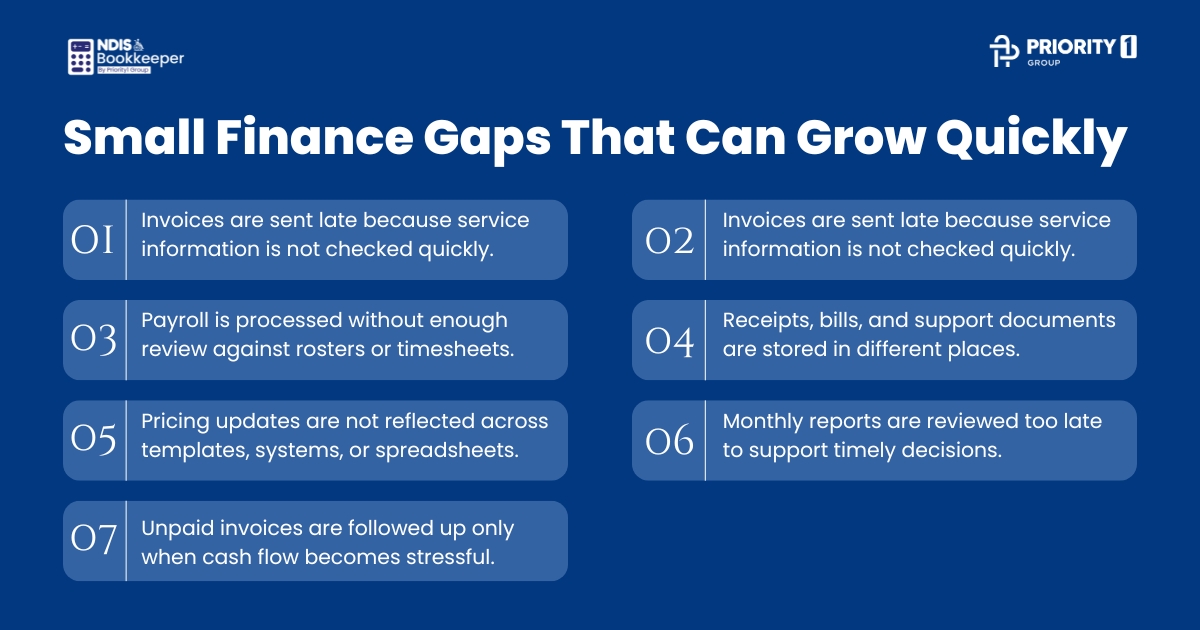
Many bookkeeping problems start small. They may not seem urgent in the moment, but they can create bigger issues if they continue over time.
These gaps are common in growing NDIS businesses because the workload increases faster than the financial process. The goal is not to blame the team. It is to create a bookkeeping process that is realistic, consistent, and easier to maintain.
NDIS bookkeeping is not only about recording transactions. It is about understanding how financial records connect with participant services, staff hours, claims, payroll, and reporting. A provider needs more than someone who can update accounts. They need support that understands why the details matter.
A provider searching for a bookkeeper ndis solution should look for help that goes beyond basic data entry. The right support should help keep records organised, improve cash flow visibility, review financial reports, and support better preparation when information is needed.
This type of support is especially important when providers are growing. More participants can mean more claiming activity. More workers can mean more payroll complexity. More services can mean more reporting pressure. Without a stronger system, the provider may spend too much time fixing problems instead of preventing them.
Claiming is one of the biggest areas where NDIS providers need accuracy. When price guide updates are released, providers need to check whether their rates, invoices, service agreements, and records still align. If old rates remain in templates or software, errors can continue across multiple claims.
A small claiming mistake can take time to correct later. It may require checking records, comparing service dates, reviewing support items, and adjusting invoices. For providers wanting to understand this issue in more detail, this blog on common claiming mistakes after NDIS price guide updates explains how pricing changes can affect claims, invoices, payroll planning, and financial records.
Payroll can also become stressful when records are not clear. Rosters, timesheets, service delivery records, allowances, and payroll entries may all need to align. If one part is missing or unclear, the provider may spend extra time checking details, correcting errors, or answering staff questions. Better bookkeeping helps support payroll by making wage costs, payment timing, and service records easier to review.
Good bookkeeping should make the business easier to understand. It should not overwhelm providers with information they cannot use.
This type of visibility helps providers make decisions earlier. Instead of waiting until there is a cash flow problem, they can see warning signs and respond with more confidence.
Monthly reports are one of the most useful tools for NDIS providers, but only when the records behind them are accurate and current. A monthly report should help the provider understand income, expenses, wages, unpaid invoices, cash flow, and changes in business performance.
Without regular reporting, providers may rely too much on the bank balance. The bank balance is useful, but it does not show unpaid invoices, upcoming payroll, tax obligations, supplier bills, or costs increasing over time.
This is where bookkeeping for ndis becomes more than admin support. It helps providers use financial information to make calmer, better-informed decisions. Instead of guessing whether the business can afford to hire, expand, or invest in systems, the provider can review the numbers properly.
Many providers manage bookkeeping internally in the early stages. This can work while the business is small. But as the provider grows, the internal team may become stretched. Financial tasks may start falling behind, not because people are careless, but because there is too much to manage.
For a broader business perspective, Outsourced Bookkeeper shares helpful insights into how external bookkeeping support can help growing businesses stay organised. Providers can also read this guide on why outsourced bookkeeping helps growing businesses to understand how outsourcing can support time management, financial structure, and business growth.
For NDIS providers, the benefit is not only saving time. It is also about creating a stronger financial routine. Clean records, regular reports, and better payroll visibility can reduce pressure on managers and help the business operate with more confidence.
Audit readiness should not begin when an audit is already approaching. It should be built into everyday financial habits. Clean invoices, matched payments, reconciled accounts, organised payroll records, and saved supporting documents all help create a stronger record trail.
Being prepared does not mean everything has to be perfect. It means the provider has a clear process and reliable records. When information is organised throughout the year, providers are less likely to feel rushed when documents are needed.
Before relying on a basic setup, providers should ask:
If the answers are unclear, the provider may need stronger bookkeeping support. This does not mean the current system has failed. It simply means the business may have grown beyond a basic process.
NDIS providers need more than basic bookkeeping because their financial records are closely connected to claims, payroll, participant services, pricing changes, reporting, cash flow, and audit readiness. A simple record-keeping approach may work at the beginning, but as the business grows, providers often need stronger systems and clearer financial visibility.
The goal is not to make bookkeeping complicated. The goal is to make it more useful. With cleaner records, regular reports, stronger payroll visibility, and organised financial routines, providers can reduce pressure and make better decisions. NDIS Bookkeeping by Priority1 Group.