

NDIS pricing updates can feel like a small change on paper, but for providers, they can create a long list of practical tasks. Rates may need to be checked. Invoices may need to be reviewed. Service agreements may need attention. Payroll planning may need a second look. Reports may need to reflect new income expectations. For a small or growing NDIS provider, this can quickly become overwhelming when the team is already focused on participants, rostering, staff support, and daily operations.
The difficult part is not only reading the update. The real challenge is making sure the update is reflected properly across the business. A provider may understand that pricing has changed, but if old rates remain in software, spreadsheets, templates, or internal notes, claiming mistakes can still happen. This is where financial systems and bookkeeping routines become important.
Outsourced bookkeepers can help providers turn pricing updates into clear financial action. They can support invoice checks, reconciliation, reporting, payroll records, cash flow visibility, and audit-ready documentation. Instead of leaving the update as a task for “later”, providers can build a process that helps reduce confusion and keeps their records current.
When pricing updates are released, it can be tempting to read the main points and move on. However, NDIS providers need to think beyond the document itself. A pricing update may affect the way the business records income, checks claims, manages service-related billing, monitors unpaid invoices, and prepares reports.
This matters because NDIS businesses rely on accurate information across several connected areas. A rate used in an invoice may affect expected income. Expected income may affect cash flow planning. Cash flow planning may affect payroll timing. Payroll timing may affect how confident the provider feels about hiring or expanding services.
If one part of the system is not updated properly, the financial picture can become unclear. Providers may not immediately notice the issue, especially if claims are still being submitted and payments are still coming in. However, the problem may appear later during reporting, reconciliation, audit preparation, or internal review.
This is why pricing updates should not be treated as a one-person task. They should be translated into a practical workflow that involves billing, bookkeeping, payroll, and management review.
Many NDIS providers are already managing a heavy workload. They are trying to support participants well, coordinate staff, meet compliance expectations, respond to families, manage service agreements, and keep the business financially stable. When pricing updates arrive, they add another layer of responsibility.
The pressure often comes from uncertainty. Providers may ask: Are we using the right rates? Have our templates been updated? Are claims being checked before submission? Are our reports showing the correct income? Are unpaid invoices being followed up properly? Has payroll been considered in light of income changes?
These questions are important, but they can be hard to answer when records are scattered or when bookkeeping is only reviewed at the end of the month. Providers need a financial process that helps them respond earlier, not after mistakes have already been repeated.
This is where outsourced support can be practical. It gives providers access to regular financial assistance without needing to build a larger internal finance team straight away.
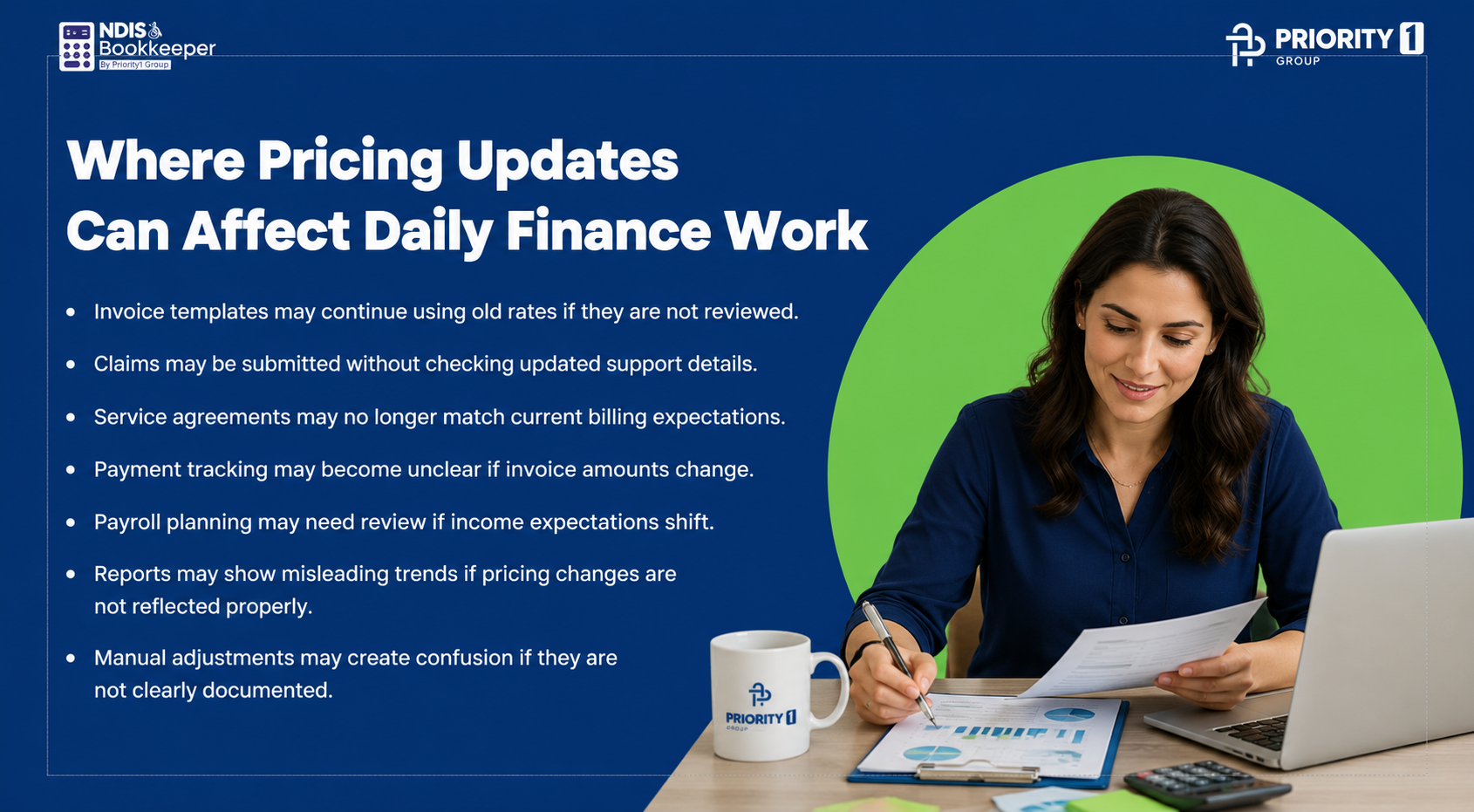
Pricing updates can touch more areas of the business than providers may first expect. The impact is not always dramatic, but small gaps can still affect accuracy.
These are not unusual issues. They often happen because teams are busy and updates are applied in stages. An outsourced bookkeeper can help create a more consistent process so that financial records do not fall behind operational changes.
An outsourced bookkeeper does not simply record transactions after they happen. In a well-managed process, they help organise the financial details that allow the provider to make better decisions. After a pricing update, this can include reviewing invoice records, checking payment allocation, reconciling bank activity, monitoring outstanding amounts, and preparing reports that show what has changed.
For example, if pricing changes affect expected income, the provider needs to understand how this may influence cash flow. If invoice amounts change, the business needs to check whether payments received match the correct invoices. If manual adjustments are made, there should be clear notes so the record can be understood later.
A skilled ndis bookkeeper can also help providers build stronger routines around pricing reviews. This may include creating a checklist for rate updates, checking that billing systems are aligned, and supporting monthly review processes. The aim is not to make the provider dependent on complex reporting, but to make everyday financial information clearer and easier to trust.
This support is especially helpful for small providers that may not have a dedicated finance department. Instead of stretching internal admin staff across too many responsibilities, providers can use external bookkeeping support to keep financial tasks moving consistently.
Pricing updates can affect cash flow in quiet ways. If old rates are used, income may not reflect the current pricing structure. If invoices are delayed while the team checks updates, payments may come in later than expected. If claims require correction, admin time increases and financial visibility becomes less clear.
Cash flow is not only about money in the bank. It is about understanding what money is expected, what has been received, what is overdue, and what obligations are coming up. After pricing changes, this visibility becomes even more important.
Providers that already struggle with delayed invoicing, unpaid claims, or unclear reporting may feel the impact more strongly. This is why it is useful to connect pricing update management with wider financial routines. Common Claiming Mistakes After NDIS Price Guide Updates, as it will help you understand where pricing-related errors often begin.
Monthly reporting gives providers a practical way to check whether the business is adjusting properly after pricing updates. It helps show whether income patterns have changed, whether outstanding invoices are increasing, whether payroll remains manageable, and whether operating costs are putting pressure on margins.
Without monthly reporting, providers may rely only on the bank balance. While the bank balance is useful, it does not show the full story. It may not include unpaid invoices, upcoming payroll, delayed payments, supplier bills, tax obligations, or reporting gaps.
Monthly reports can help providers see whether pricing updates have created any unexpected changes. If income is lower than expected, the provider can investigate earlier. If unpaid invoices are increasing, follow-up can happen before cash flow becomes tight. If payroll costs are rising faster than income, the provider can review rosters, service delivery, or business planning.
This is one of the strongest reasons to treat bookkeeping as an ongoing business function rather than a task completed only when records are overdue.
After pricing changes, providers benefit from a structured review process. This helps reduce repeated errors and makes it easier to keep records clean.
This kind of review gives providers a clearer starting point. Instead of wondering whether everything has been updated, they can work through a practical process and identify gaps early.
Internal admin teams in NDIS businesses often manage many responsibilities. They may handle participant communication, roster updates, staff documents, incident records, service bookings, invoice requests, and general operations. Adding pricing update checks to this workload can create pressure, especially if the team is already stretched.
Outsourced bookkeeping support can ease that pressure by taking ownership of specific finance tasks. This does not remove the provider’s responsibility to understand and manage the business, but it does create a stronger support system around financial records.
It also helps reduce last-minute work. Instead of waiting until month-end, tax time, or audit preparation, records can be reviewed regularly. This gives managers more confidence because they are not constantly trying to catch up.
When financial tasks are handled consistently, the provider can focus more energy on service quality, staff support, and participant outcomes.
Audit readiness is not created overnight. It comes from keeping records organised throughout the year. Pricing updates make this even more important because providers may need to show that claims, invoices, payments, and supporting documents are accurate and aligned.
If records are incomplete, it becomes harder to explain what happened. The provider may need to search through emails, spreadsheets, bank records, rosters, or service notes to confirm details. This creates stress and takes time away from normal operations.
With better bookkeeping processes, providers can keep a clearer trail. Invoices can be matched to payments. Payroll can be reviewed against rosters and timesheets. Adjustments can be noted properly. Reports can show financial activity more clearly.
This does not mean every provider will avoid every question or review. It means the business is better prepared to respond with confidence when information is needed.
General admin support is valuable, but NDIS financial work often needs a more focused approach. Pricing updates, claims, participant billing, payroll records, and reporting all connect to the financial health of the provider. A small error can affect more than one part of the business.
This is why ndis bookkeeping should be handled with sector awareness. Providers need someone who understands that the records are not just numbers. They are connected to services delivered, staff paid, participants supported, and business decisions made.
Specialist support can also help providers avoid common patterns that create financial stress. These include late invoicing, unclear payment matching, missing documents, delayed reconciliations, and reports that are reviewed too late to be useful.
Pricing updates are not only an NDIS issue. They sit within a wider business finance environment where payroll, compliance, reporting, and cash flow all need attention. This is where Outsourced Bookkeeper is also useful to mention as another Priority1 Group subdomain that supports businesses with remote bookkeeping, payroll preparation, and financial organisation.
For example, many Australian businesses are also preparing for Payday Super, which can affect payroll routines and cash flow planning. This related guide on Payday Super and small business bookkeeping preparation explains why businesses should review payroll settings, reporting habits, and bookkeeping systems before major compliance changes.
This broader view helps providers stay proactive. Instead of responding to each update separately, they can build a stronger finance routine that supports the business through different changes.
Before and after pricing updates, providers can ask simple but important questions. These questions help turn uncertainty into action.
These questions are practical because they focus on what providers can control. They also help improve communication between business owners, managers, admin teams, and bookkeepers.
NDIS pricing updates will continue to be part of provider operations. Rather than treating each update as a stressful event, providers can create a repeatable process. This may include reviewing the update, checking affected systems, updating templates, communicating changes to the team, reviewing claims, and checking reports after the first billing cycle.
A repeatable process helps reduce confusion. It also supports business continuity because everyone understands what needs to happen. Providers can avoid relying on memory or rushing through checks at the last minute.
Outsourced bookkeepers can help create and maintain this rhythm. They can support the provider with regular financial tasks, highlight gaps, and make sure records are easier to review. This gives the business more confidence when pricing changes, payroll changes, or reporting deadlines arise.
For growing providers, this support can be especially valuable. Growth brings more services, more records, more staff, and more financial activity. A strong bookkeeping system helps the provider grow with better control.
NDIS pricing updates can affect claims, invoices, reports, payroll planning, cash flow, and audit readiness. For small and growing providers, the challenge is not only understanding the update but making sure it is applied properly across everyday financial processes.
Outsourced bookkeepers can help providers manage this work with more structure. They support clean records, regular reporting, payment tracking, payroll visibility, and better preparation for reviews. This gives providers more confidence and reduces the pressure on internal teams.
The goal is not to make bookkeeping more complicated. The goal is to make the financial side of the business clearer, more reliable, and easier to manage through change. For providers that want practical support with pricing updates, cleaner records, and stronger reporting, NDIS Bookkeeping by Priority1 Group.