

When NDIS pricing updates are released, most providers understand that something needs to be reviewed. The difficult part is knowing exactly what needs to change inside daily operations. A price guide update is not just a document to read once and file away. It can affect service rates, claiming habits, invoice checks, payroll planning, cash flow expectations, and the way financial records are reviewed.
For small and growing NDIS providers, this can feel like one more pressure added to an already busy workload. There are participants to support, staff to roster, invoices to manage, service agreements to check, and payments to follow up. When pricing changes are not carefully reflected in the bookkeeping system, small claiming errors can quietly begin.
These mistakes are not always obvious at first. A provider may continue using old rates, miss a support item update, forget to review cancellation rules, or process claims without checking whether the supporting records still match the current pricing arrangement. Over time, these small gaps can affect cash flow, reporting accuracy, and compliance confidence.
The purpose of this blog is not to make price guide updates sound overwhelming. Instead, it is to help NDIS providers understand where claiming mistakes usually happen and how better bookkeeping processes can reduce the pressure.
NDIS pricing updates matter because they influence how providers charge for supports. Even when the change seems small, the impact can spread across invoices, service agreements, payroll calculations, participant records, and internal reports. If a business continues using an older process after a pricing update, the risk is not just one incorrect claim. The same mistake may be repeated across multiple participants or billing cycles.
This is especially important for providers delivering regular supports. When services are ongoing, claiming often becomes routine. A team may process invoices the same way each week or month because the process has worked before. However, after a pricing update, the routine itself needs to be reviewed.
A common issue is that pricing updates are read by one person but not fully communicated to the team responsible for billing, payroll, rostering, and record-keeping. This creates a gap between what the provider knows and what the system actually does. The business may believe it is updated, while old information is still being used in templates, software, spreadsheets, or internal checklists.
Claiming errors often begin in simple places. They may not look like major financial mistakes at first. In many cases, they are small admin gaps that happen because the provider is busy, the team is stretched, or the pricing change has not been translated into everyday workflows.
The first place to check is usually the connection between services delivered and claims submitted. If a support was delivered under one arrangement but claimed under another, the record may become difficult to explain later. Providers should be able to show what was delivered, when it was delivered, who delivered it, what was charged, and why that amount was used.
Another risk area is service agreements. If rates or claiming conditions change, providers may need to review whether participant documents, internal notes, and billing processes still reflect the current arrangement. When these documents are not aligned, the bookkeeping record may look incomplete even if the service was delivered properly.
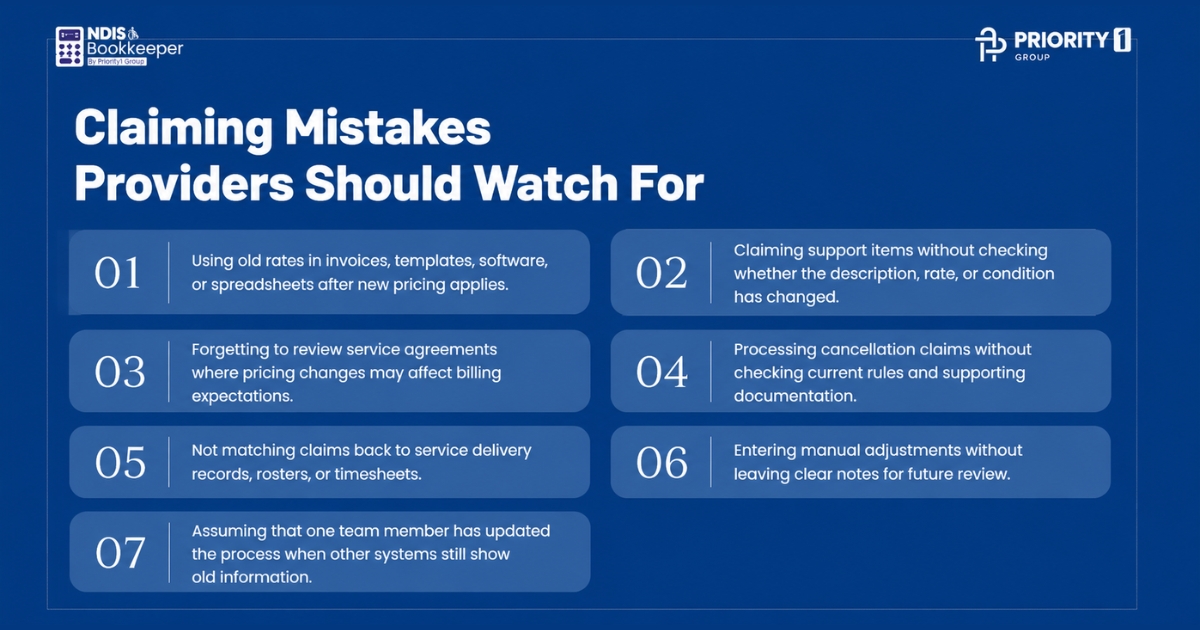
After a price guide update, NDIS providers should slow down and check the areas where repeated errors are most likely to occur. This does not mean stopping business operations. It means building a short review process before the same mistake is carried into future claims.
These mistakes can happen even in well-managed organisations. The key is to create a process that catches them early. A provider that reviews pricing updates carefully can reduce rework, improve reporting accuracy, and feel more confident if records are questioned later.
Reading a pricing update is only the first step. The real value comes from turning that update into clear financial action. This is where bookkeeping plays an important role. A bookkeeper can help providers check whether the update has been reflected across invoices, accounts, payroll records, and reports.
Good bookkeeping does not simply record what has already happened. It helps the provider notice whether the financial process still makes sense. If rates have changed, the bookkeeping system should help identify whether invoices are correct, whether income is being recorded accurately, and whether unpaid amounts are being tracked properly.
Providers also need to think about timing. If claims are delayed because the team is unsure about new rates, cash flow can be affected. If claims are submitted too quickly without checks, corrections may be needed later. Both situations create pressure. A balanced process helps providers stay accurate without slowing down unnecessarily.
For providers that have already experienced pressure from delayed invoices or unclear records, this related article on bookkeeping gaps that affect NDIS cash flow connects well with the same issue from a cash flow perspective.
Many claiming mistakes become harder to fix because they are not handled immediately. A team might notice a small issue and plan to correct it later, but by then more claims may have been processed using the same information. What started as one error can become a larger clean-up task.
This is where providers can lose valuable time. Instead of focusing on service delivery and business improvement, managers may need to go back through old invoices, compare support items, review participant records, check bank payments, and explain adjustments. The work becomes more stressful because it is no longer current.
A “fix it later” habit can also affect financial visibility. If claims, invoices, and payments are not accurate, reports may not show the true position of the business. The provider may think income is higher or lower than it actually is. Payroll and expense planning can also become harder if income timing is uncertain.
For growing providers, this is a serious concern. Growth usually means more participants, more claims, more staff, and more financial activity. If the bookkeeping system is already carrying small errors, growth can make those errors harder to control.
There comes a point where doing everything internally may no longer be practical. This does not mean the provider has failed. It often means the business has grown and now needs stronger financial support. Some providers choose to outsource ndis bookkeepers because they need regular help with invoices, reconciliations, payroll records, reporting, and claim-related financial checks.
Outsourced support can be especially useful after pricing updates because it gives the provider another layer of review. Instead of relying on memory or scattered internal notes, the bookkeeping process can become more structured. The provider can check whether rates are updated, whether invoices are consistent, and whether financial reports show the right information.
This support also helps reduce pressure on internal admin teams. Many NDIS teams are already handling participant communication, staff coordination, compliance documents, and daily service issues. When bookkeeping is handled with consistency, the internal team has more space to focus on operations.
For NDIS providers that want to understand this topic from a wider business finance angle, Outsourced Bookkeeper offers helpful insights into remote bookkeeping, payroll preparation, and financial organisation for Australian businesses.
Providers can also read this related guide on How NDIS pricing updates affect provider bookkeeping to understand how pricing changes can influence financial records, reporting habits, and business planning.
Providers do not need a complicated system to reduce claiming mistakes. What they need is a clear review process that is followed every time a price guide update is released. This makes the update easier to manage and reduces the risk of missing important changes.
This process gives providers a practical way to move from uncertainty to action. It also creates a stronger record trail. If a question comes up later, the provider can show that the update was reviewed, applied, and checked.
Pricing updates are often discussed in relation to claims and invoices, but payroll should not be ignored. For many NDIS providers, staff wages are one of the largest expenses in the business. If pricing changes affect revenue expectations, providers need to understand how that connects with staff costs, roster patterns, and service delivery.
Payroll and claims do not sit in separate worlds. A support worker may deliver a service that later needs to be claimed correctly. If the roster, timesheet, invoice, and payroll record do not align, the financial picture becomes unclear. This can affect reporting and make it harder to understand whether the service was financially sustainable.
Providers should also review whether increased admin time is being created by pricing changes. If staff are spending more time checking claims, fixing invoices, or clarifying errors, that time has a cost. Better bookkeeping processes can reduce this by creating cleaner workflows from the beginning.
Strong financial records help providers feel more prepared. When claims are supported by clear documentation, invoices are checked before submission, and reports are reviewed regularly, the provider has more confidence in its numbers.
This does not mean every provider needs to become a pricing expert. It means the business should have a system that supports accuracy. The team should know where to find current information, who is responsible for updating records, and how claims are checked before they are submitted.
Specialist bookkeeping for ndis providers can help connect the financial details with the practical realities of running an NDIS business. It supports the provider with clearer records, better reporting, and a stronger process for managing changes that affect claims and cash flow.
Price guide updates can feel disruptive, but they can also be an opportunity to improve financial systems. Each update gives providers a reason to review how claims are handled, how invoices are checked, how reports are used, and how financial responsibilities are shared.
A strong routine may include regular reconciliation, invoice reviews, payroll checks, service agreement reviews, document storage, and monthly reporting. The goal is not to create unnecessary admin. The goal is to make the financial process easier to trust.
When providers take this approach, they are less likely to be caught off guard by changes. They can respond sooner, reduce errors, and make decisions with clearer information. This is especially valuable for providers that are growing or managing multiple services.
Before the next claim run after a pricing update, providers should pause and ask a few practical questions. These questions can help catch issues before they become repeated mistakes.
These questions are simple, but they create accountability. They also help providers avoid relying only on memory. When the same review steps are followed consistently, the business becomes less vulnerable to avoidable claiming errors.
NDIS price guide updates can affect more than the rate a provider charges. They can influence claims, invoices, payroll planning, service agreements, reporting, and cash flow. When updates are not reflected properly in the bookkeeping process, small mistakes can quietly become bigger financial and compliance concerns.
The best response is a practical one. Providers should review rates, update systems, check supporting records, monitor invoices, and keep reporting current. With a clear process, pricing changes become easier to manage and less stressful for the team.
For small and growing providers, the aim is not to make financial management complicated. The aim is to create a routine that keeps claims accurate, records clear, and decisions better informed. With the right bookkeeping support, providers can manage pricing updates with more confidence and less last-minute pressure. NDIS Bookkeeping by Priority1 Group.