
Running an NDIS business comes with a responsibility that goes far beyond everyday service delivery. Providers are supporting people with real needs, coordinating staff, managing participant expectations, handling invoices, tracking claims, and staying prepared for compliance checks. In the middle of all this, financial records can easily become something that gets updated only when there is time.
The challenge is that “when there is time” often comes too late. A missed invoice, an unrecorded payment, unclear payroll details, or incomplete supporting documents can create stress when reports are needed urgently. For many small and growing NDIS providers, this is where financial pressure builds quietly. The business may be delivering good services, but if the records do not clearly show what happened, when it happened, and how money moved, it becomes harder to stay confident.
Clean financial records are not only useful at tax time. They help providers understand cash flow, prepare for reviews, support claims, manage wages, and make better decisions. More importantly, they create a sense of control. When records are updated, organised, and easy to follow, providers can respond faster, plan better, and reduce the risk of last-minute confusion.
NDIS providers work in a sector where accuracy matters. Every service delivered, every invoice sent, every payment received, and every wage processed needs to be backed by reliable information. This does not mean providers need to feel overwhelmed by paperwork. It means the financial side of the business should be structured enough to support daily operations.
Financial readiness is about being prepared before someone asks for information. It means knowing where records are stored, whether income has been matched correctly, whether expenses are categorised clearly, and whether payroll details are aligned with actual work completed. For an NDIS provider, this can make a major difference when dealing with internal reviews, accountant requests, audits, or business planning.
A provider with clean records can quickly answer important questions. Are payments coming in on time? Are staff costs increasing? Are invoices being raised correctly? Are there services delivered but not yet billed? Is there enough cash flow to support the next stage of growth? Without organised bookkeeping, these questions become harder to answer with confidence.
This is especially important for growing providers. As participant numbers increase, financial activity becomes more complex. More staff, more invoices, more claims, more supplier bills, and more compliance expectations all add pressure. Clean records help stop that growth from turning into operational chaos.
Clean financial records are not just tidy spreadsheets or neatly saved receipts. They are records that tell the full financial story of the business in a way that is accurate, current, and easy to understand.
For NDIS providers, this usually means keeping participant-related income, business expenses, payroll records, bank transactions, invoices, and supporting documents organised. It also means making sure records are reviewed regularly, not only when something goes wrong.
A good financial system should help providers clearly see what money has come in, what money is still expected, what costs have been paid, and what obligations are coming up. When this information is available, business owners and managers can make decisions based on facts rather than guesswork.
Clean records also support better conversations with accountants, bookkeepers, auditors, and internal teams. Instead of spending time searching for missing information, the focus can shift to understanding the numbers and improving the business.
Some NDIS providers only realise their records need improvement when they are already under pressure. However, there are usually early signs that the bookkeeping process needs better structure.
These signs do not always mean something is seriously wrong. Often, they simply show that the business has grown faster than its financial systems. The important step is to improve the process before small gaps become bigger problems.
Compliance can feel stressful for providers, especially when financial records are incomplete or difficult to explain. Clean bookkeeping does not remove every compliance responsibility, but it does make preparation much easier.
When income, expenses, payroll, invoices, and documents are organised, providers can show a clearer connection between services delivered and money received. This creates a stronger foundation for internal checks and external reviews. It also helps reduce the pressure on managers who may otherwise need to pull information together at the last minute.
Many providers also find that regular bookkeeping helps them identify issues earlier. For example, they may notice delayed payments, repeated invoice corrections, payroll inconsistencies, or unusual expense patterns. These are much easier to manage when they are found early rather than months later.
If your organisation is preparing for a review or wants to better understand what financial readiness involves, this guide on NDIS financial audit preparation is a useful next step.
Bookkeeping is often seen as a technical task, but for NDIS providers, it also has a human side. Behind every invoice and payroll entry are participants, support workers, coordinators, families, and business owners trying to do things properly.
When records are messy, the stress usually lands on people. Managers spend evenings looking for documents. Admin teams chase missing information. Business owners worry about cash flow. Staff may have questions about payments. Accountants may need urgent clarification. Over time, this creates unnecessary pressure across the organisation.
Clean financial records reduce that pressure. They give teams a clearer way to work. They also help providers protect time and energy for the part of the business that matters most: supporting participants well.
This is where specialist support can make a practical difference. Working with an ndis bookkeeper can help providers manage records in a way that reflects the real needs of the sector, from payroll and invoicing through to reporting and financial organisation.
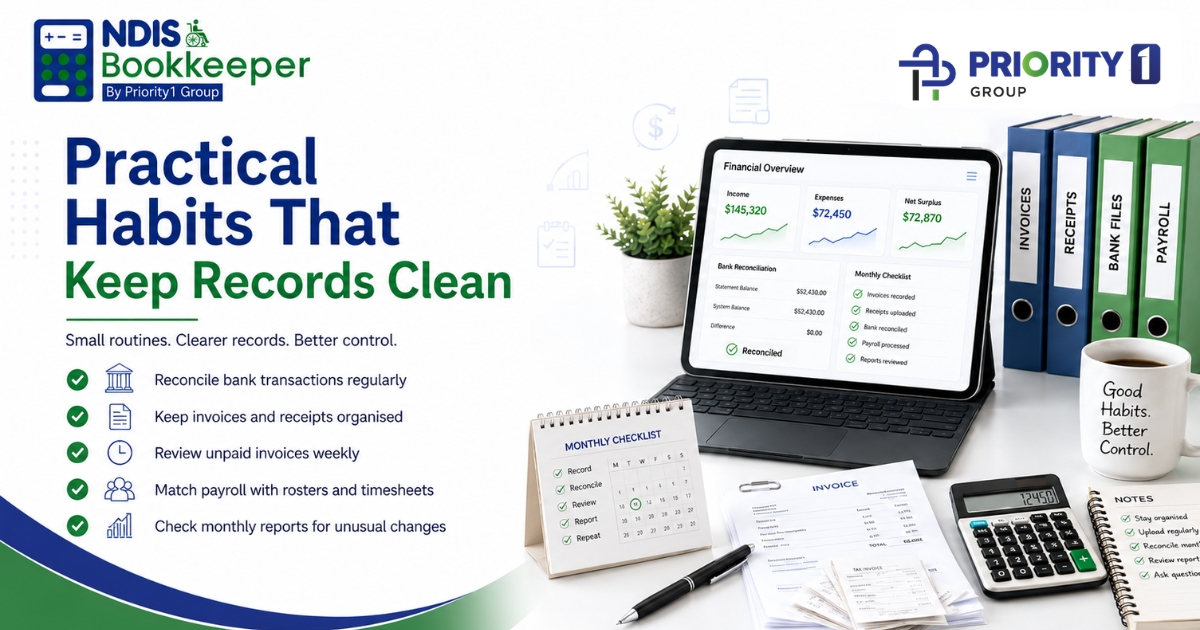
Clean records are usually the result of small, consistent habits rather than one big clean-up at the end of the year. Providers do not need to make the process complicated. They need a routine that is realistic, repeatable, and easy for the team to follow.
Technology can be especially helpful when used properly. Digital tools can support better document storage, automated transaction matching, reporting, and communication between bookkeeping and management teams. This article on how technology is transforming modern bookkeeping explains how modern systems can make financial processes more efficient.
A monthly review gives NDIS providers a regular opportunity to pause and understand the financial position of the business. It does not need to be complicated, but it should be consistent.
During a monthly review, providers can look at income, expenses, payroll, unpaid invoices, upcoming payments, and overall cash flow. This helps identify whether the business is financially stable, whether costs are increasing, or whether any areas need attention.
Monthly reviews also support better planning. If a provider wants to hire more staff, expand services, invest in systems, or open support in a new location, financial reports provide the evidence needed to make those decisions carefully.
Without regular reviews, business owners may rely on bank balance alone. While the bank balance is useful, it does not show the full picture. It may not reflect unpaid bills, outstanding invoices, upcoming payroll, tax obligations, or seasonal changes in income. Clean records help create a more complete view.
This is one reason ndis bookkeeping should be treated as an ongoing business function, not just an admin task. When records are maintained throughout the month, financial reviews become clearer and more useful.
Good decisions need reliable information. For NDIS providers, this can include decisions about staffing, pricing, service delivery, cash flow, and growth. If the financial records are unclear, decisions can become reactive instead of planned.
For example, a provider may feel busy but still struggle with cash flow. Clean records can help show whether the issue is delayed invoicing, high staff costs, unpaid claims, or poor expense tracking. Without that clarity, the provider may not know where to focus.
Clean records also help providers understand whether growth is sustainable. More participants can increase income, but they can also increase payroll, admin, transport, software, training, and compliance costs. Financial reports help providers see whether the business is growing in a healthy way.
This type of visibility gives business owners more confidence. Instead of guessing what is happening, they can look at accurate reports and make decisions based on real numbers.
Being financially ready does not mean everything must be perfect. It means the provider has enough structure, consistency, and clarity to respond when information is needed.
These questions help providers identify where improvements are needed. Some businesses may only need small changes, such as better document storage or more regular reconciliations. Others may need a stronger bookkeeping process, better reporting, or specialist support.
The goal is not to create extra work. The goal is to build a system that makes everyday financial management easier.
Clean financial records become easier when they are part of the normal routine. Providers should not wait for tax time, audit preparation, or cash flow stress before reviewing their books. A steady routine helps prevent avoidable pressure.
This routine might include weekly invoice checks, fortnightly payroll reviews, monthly reconciliations, and regular management reporting. It may also include setting aside time to review outstanding payments, check documents, and discuss financial questions with the bookkeeping team.
The most effective routines are simple enough to maintain. If a process is too complicated, it often gets delayed. A practical system should fit the size of the business, the capacity of the team, and the level of reporting needed.
For growing NDIS providers, this structure can provide peace of mind. It allows the business to focus on service quality while still keeping the financial side organised and ready.
Clean financial records help NDIS providers stay prepared, not just for audits or accountant requests, but for everyday business decisions. They support better cash flow, clearer reporting, smoother payroll, stronger compliance confidence, and less pressure on the team.
For small and growing providers, the aim is not perfection. The aim is to create a reliable system where financial information is updated, organised, and easy to understand. With the right bookkeeping habits and the right support, providers can feel more confident about where their business stands and what needs attention next.
For providers who want clearer records, stronger reporting, and more confidence in their financial processes, NDIS Bookkeeping by Priority1 Group can support a more organised and ready approach.