

Managing finances within the NDIS sector requires more than simply tracking income and expenses. Providers must navigate strict compliance obligations, participant funding structures, payroll complexities, invoicing systems, and reporting requirements while continuing to deliver quality support services.
As the NDIS industry continues to evolve, financial management has become a shared responsibility across multiple departments within an organisation. It is no longer limited to accountants or finance teams alone. Rostering staff, support coordinators, operations managers, payroll teams, and administrators all play a role in maintaining financial accuracy and compliance.
Without proper staff training, providers may experience invoicing delays, payroll errors, claim rejections, cash flow issues, and audit risks. Training your team on NDIS financial management helps create consistency, accountability, and operational confidence across the organisation.
This article explores why financial training matters in the NDIS sector, the key areas staff should understand, and how providers can build stronger internal financial systems through education and collaboration.
Many providers assume financial management is handled solely by bookkeepers or external accountants. However, daily operational decisions made by support workers, coordinators, and administrators can directly impact financial outcomes.
For example:
Financial management works best when every team member understands how their role contributes to the overall financial health of the organisation.
Training staff creates:
Providers that build financially aware teams are often more efficient, scalable, and audit-ready.
Every staff member does not need to become a financial expert. However, each department should understand the financial impact of its daily responsibilities.
Support workers should know the importance of accurate timesheets and participant documentation. Coordinators should understand budget monitoring and service utilisation. Administrators should understand invoice tracking and claims management. Leadership teams should understand financial reporting and operational sustainability.
Training should focus on helping staff connect their day-to-day tasks with broader organisational outcomes.
This approach improves communication between departments and reduces the likelihood of operational silos that often create financial inconsistencies.
Effective financial training starts with creating a structured learning process that is practical, easy to understand, and relevant to the organisation’s operations.
Instead of overwhelming staff with technical accounting concepts, providers should focus on real operational scenarios that employees encounter daily.
Participant Funding Basics- Staff should understand how participant funding works, including different support categories and budget limitations.
Service Agreements- Employees involved in service delivery should understand the importance of accurate agreements and approved support scopes.
Timesheet Accuracy- Incorrect timesheets can affect payroll, invoicing, and participant claims simultaneously.
Payroll Compliance- Teams should understand the importance of award interpretation, shift classifications, and accurate scheduling.
Claiming Processes- Administrative staff should know how claims are submitted, reviewed, and reconciled.
Documentation Standards- Good documentation supports both compliance and financial accuracy.
When training focuses on operational relevance, staff are more likely to apply the knowledge consistently.
Financial management within disability services works best when departments collaborate rather than operate independently.
In many organisations, finance teams only discover problems after issues have already escalated. For example, payroll teams may identify incorrect shift entries weeks after services were delivered.
Creating cross-department collaboration can reduce these problems significantly.
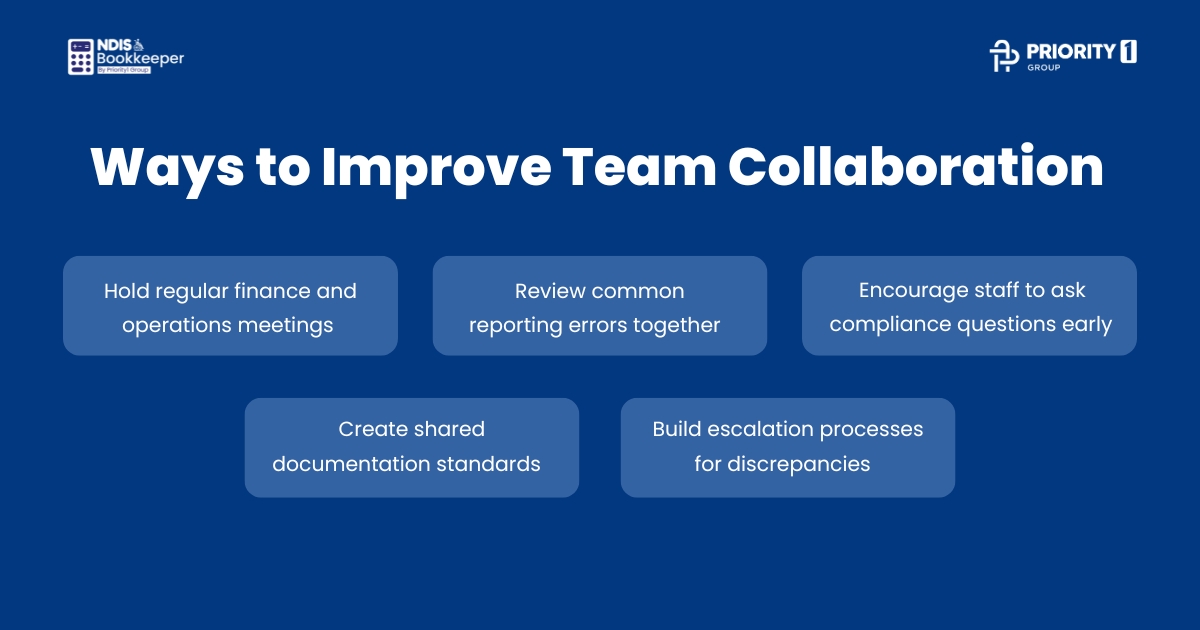
Open communication helps teams identify patterns and resolve issues before they impact participants or business operations.
Consistency is one of the most important aspects of effective financial management.
Without standardised processes, organisations often rely too heavily on individual staff habits or undocumented procedures. This creates operational risks when employees leave or responsibilities change.
Standardisation helps ensure that tasks are completed correctly regardless of who performs them.
Many providers also work with external financial specialists like Outsourced Bookkeeper to improve consistency, reporting accuracy, and financial visibility across daily operations.
Timesheet Submission Procedures- Clear deadlines and formatting expectations improve payroll accuracy.
Invoice Approval Workflows- Defined approval processes reduce billing delays and inconsistencies.
Documentation Requirements- Staff should understand exactly what information must be recorded after supports are delivered.
Participant Budget Monitoring- Regular budget reviews help prevent overspending or funding interruptions.
Financial Reporting Procedures- Leadership teams should receive consistent reporting formats to support decision-making.
Strong systems reduce confusion and improve overall operational stability.
Technology can significantly improve financial training and operational consistency within NDIS organisations.
Integrated systems help teams manage:
However, technology alone is not enough. Staff still need proper training on how to use systems correctly and consistently.
Providers should ensure employees understand:
Training sessions should include practical demonstrations and real-world examples rather than theoretical instruction alone.
The NDIS sector continues to face increasing scrutiny around compliance, financial transparency, and operational accountability.
Providers who fail to maintain proper financial records may experience:
Staff education plays an important role in reducing these risks.
When employees understand the reasons behind compliance procedures, they are generally more engaged and consistent in following them.
Providers looking to strengthen financial governance may also benefit from understanding broader accounting obligations through resources such as NDIS Accounting for Nonprofits: What You Need to Know, which explores financial structures and compliance considerations within the disability sector.
Financial management directly affects participant experience, even when participants are not involved in backend operations.
When financial systems are poorly managed, participants may experience:
Strong financial processes support smoother service delivery and build trust with participants and families.
This is one reason many providers now invest in ongoing staff education and operational training rather than treating financial management as a separate administrative function.
Reliable systems also contribute to participant satisfaction and long-term provider credibility. Providers exploring flexible financial support models can also read Domestic vs. Offshore Bookkeeping: Finding the Middle Ground, which discusses how balanced bookkeeping strategies can improve operational efficiency while maintaining quality and accountability.
In many organisations, working with experienced professionals who specialise in bookkeeping for NDIS providers helps create additional operational support while allowing internal teams to focus more effectively on participant care.
As providers expand, financial complexity increases significantly. More participants, more support workers, and more operational activity often create additional pressure on internal systems.
Without proper training, growth can quickly expose weaknesses in financial processes.
Organisations that invest in staff education are usually better prepared to:
Growth becomes more manageable when teams understand both operational responsibilities and financial impacts.
For many organisations, partnering with specialists who can outsource NDIS bookkeepers provides additional expertise, consistency, and financial oversight during periods of expansion.
Training your team on NDIS financial management is not just about improving accounting processes. It is about building an organisation that operates with consistency, transparency, and confidence.
Every department contributes to financial outcomes within an NDIS business. From support workers and coordinators to payroll teams and leadership staff, each role affects compliance, cash flow, participant satisfaction, and operational stability.
Providers that prioritise financial education often experience fewer errors, stronger teamwork, improved compliance readiness, and more sustainable growth.
As the NDIS sector continues evolving, organisations with financially aware teams will be better positioned to adapt, scale, and maintain high-quality participant support.
Partnering with NDIS Bookkeeper by Priority1 Group can help providers strengthen financial systems, improve operational visibility, and create more reliable processes that support long-term success in the disability services sector.