
In the NDIS sector, client satisfaction is often associated with the quality of care provided to participants. While this is undoubtedly important, there is another critical factor that operates behind the scenes, accurate accounting. Financial accuracy plays a direct role in how smoothly services are delivered, how consistently participants receive support, and how much trust they place in their provider.
For NDIS organisations, accounting is not just about managing numbers. It is about ensuring that funding is used correctly, services are delivered without interruption, and participants experience reliability in every interaction. When financial systems are strong, the impact is felt not only within the business but also by the people it serves.
The NDIS operates within a structured and regulated framework. Funding is allocated for specific purposes, and providers must ensure that every dollar is tracked, reported, and used appropriately. Even small financial errors can create delays, confusion, or disruptions in service delivery.
Accurate accounting ensures that:
When these elements are managed effectively, participants experience a seamless service journey. On the other hand, financial inaccuracies can lead to missed supports, delayed services, and reduced confidence in the provider.
While accounting may seem like a backend function, its impact on participants is very real. Every financial process, from invoicing to payroll, affects how services are delivered.
For example, if claims are delayed due to errors, providers may face cash flow issues. This can impact staffing, scheduling, and ultimately the participant experience. Similarly, incorrect billing or misallocation of funds can create confusion for participants and their families.
Accurate financial management ensures that services are delivered consistently, without disruption. This reliability builds trust, which is a key driver of client satisfaction in the NDIS sector.
Strong financial systems create a stable foundation for service delivery. When providers have clear visibility over their finances, they can plan effectively, allocate resources efficiently, and respond to participant needs without hesitation.
A structured bookkeeping for NDIS approach ensures that all financial activities are aligned with operational goals. This alignment allows providers to focus on delivering high-quality care, knowing that their financial systems are supporting, not hindering, their efforts.
For a deeper understanding of how structured systems support financial stability, this guide on: NDIS financial management system explains how proper financial frameworks improve operational efficiency.
Accurate accounting influences multiple aspects of service delivery. Understanding these areas helps providers see the direct connection between financial management and client satisfaction.
When financial systems are efficient, providers can ensure that services are delivered on time. Accurate invoicing and claim processing prevent delays that could disrupt participant care.
Payroll accuracy ensures that support workers are paid correctly and on time. This helps maintain staff satisfaction and retention, which directly impacts the consistency of care provided to participants.
Clear and accurate financial records allow providers to communicate confidently with participants about funding, services, and costs. Transparency builds trust and reduces misunderstandings.
Minimising errors in billing, claims, and reporting creates a smoother experience for participants and their families. It also reduces the time spent resolving issues, allowing providers to focus on service delivery.
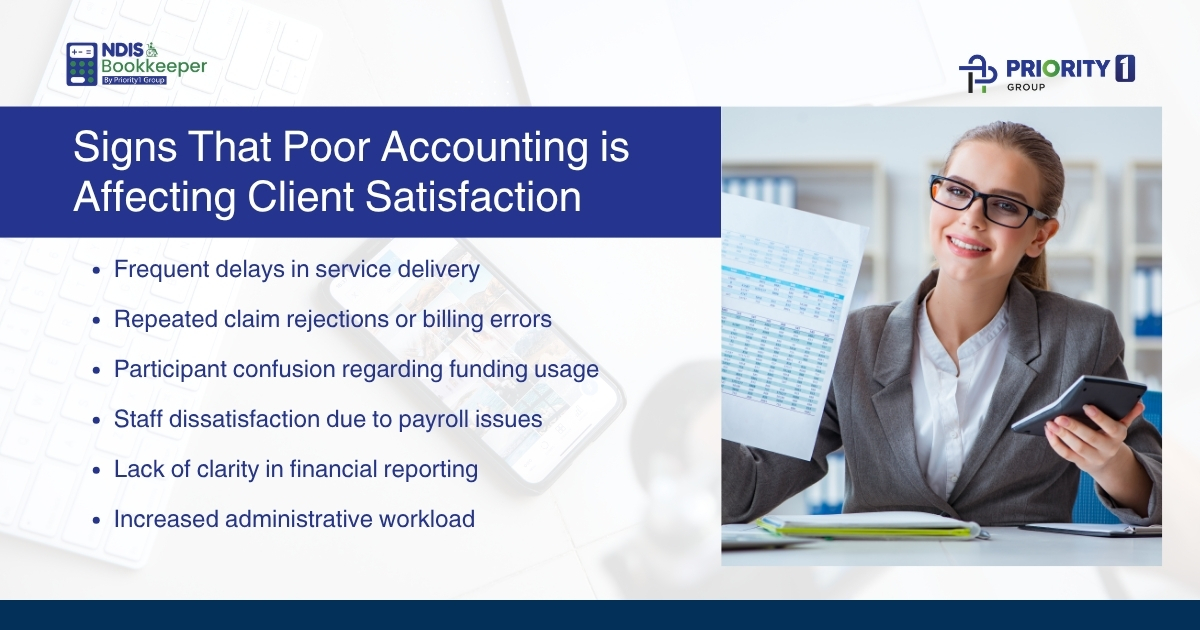
Financial inefficiencies often show up in subtle ways before they become major problems. Providers should watch for these warning signs:
These signs indicate that accounting processes may need improvement. Addressing them early can prevent larger disruptions and improve overall client experience.
Modern accounting technology plays a significant role in enhancing financial accuracy. Cloud-based systems, automation tools, and integrated platforms allow providers to manage finances more efficiently.
These tools help:
By leveraging technology, NDIS providers can streamline their financial processes and create a more reliable system that supports both compliance and service delivery.
As NDIS businesses grow, managing accounting internally can become challenging. This is where outsourcing becomes a practical and strategic solution.
Working with an Outsourced bookkeeper allows providers to access specialised expertise without increasing internal workload. It ensures that financial processes are handled accurately and consistently, reducing the risk of errors.
Outsourcing also helps providers focus on their core responsibility, delivering quality care, while financial experts manage the complexities of accounting and compliance.
To understand the cost and operational benefits of outsourcing, this resource on:
outsourced bookkeeping vs in-house provides a detailed comparison.
A professional bookkeeper ndis brings more than technical skills, they bring industry knowledge and a deep understanding of NDIS requirements. This expertise ensures that financial systems are aligned with both compliance standards and operational needs.
With expert support, providers can:
This level of financial clarity allows providers to operate confidently and deliver consistent services to participants.
The NDIS sector is evolving, with increased emphasis on accountability and transparency. Regulators expect providers to maintain accurate records and demonstrate proper use of funds.
At the same time, participants and their families are becoming more informed and expect greater clarity regarding services and funding. This shift highlights the importance of strong financial systems in building trust and maintaining satisfaction.
Providers who invest in accurate accounting are better positioned to meet these expectations and stand out in a competitive market.
To truly enhance client satisfaction, financial management should be viewed as part of the overall service experience. This means aligning financial processes with participant needs and expectations.
A client-centric approach includes:
When financial processes are aligned with service goals, the result is a smoother and more positive experience for participants.
Accurate accounting is more than a compliance requirement, it is a key driver of client satisfaction in the NDIS sector. From ensuring timely service delivery to maintaining transparency and trust, financial accuracy plays a vital role in shaping participant experiences.
Partnering with a professional NDIS Bookkeeper by Priority1 Group ensures accurate financial management and supports NDIS providers in maintaining compliance, growing their business, and providing high-quality care to participants.