
Running an NDIS business successfully requires more than just delivering exceptional care, it requires strong financial systems that support compliance, sustainability, and growth. Many providers focus heavily on participant outcomes, which is essential, but often underestimate how much financial efficiency impacts long-term success.
Financial efficiency in NDIS operations is about creating a structure where every dollar is tracked, every process is aligned, and every decision is backed by clear financial insight. It ensures that your business can operate smoothly, meet regulatory requirements, and scale without unnecessary stress.
In a highly regulated environment like the NDIS, financial efficiency is not a luxury, it is a necessity.
NDIS providers operate within fixed pricing arrangements, which means there is limited flexibility to increase revenue through pricing. As a result, efficiency becomes the key driver of profitability.
At the same time, compliance requirements are strict and continuously evolving. Financial errors are not just operational issues, they can directly impact audits, claims, and provider registration. This makes structured financial management essential for every provider.
Financial efficiency allows businesses to:
Without these elements, even a growing NDIS provider can face operational strain.
Managing finances in the NDIS space is far more complex than traditional industries. Providers must handle participant-level funding, multiple support categories, payroll obligations, and compliance documentation, all at the same time.
This is where structured ndis bookkeeping becomes essential. It ensures that financial records are accurate, funding is allocated correctly, and claims are submitted without errors.
Unlike general bookkeeping, NDIS financial management requires:
Without these systems, providers often struggle with visibility, compliance, and financial control.
Many inefficiencies in NDIS operations develop gradually. They may not seem significant at first, but over time they can create serious challenges.
One of the most common issues is delayed or incorrect invoicing. When claims are not submitted promptly or contain errors, revenue is delayed and cash flow becomes unpredictable. This creates unnecessary financial pressure on the business.
Another challenge is the misunderstanding between profit and cash flow. Many providers assume that if their business is generating income, it is financially healthy. However, without proper tracking, a business can be profitable on paper but still struggle to meet expenses. Understanding this difference is crucial, and it is explained in detail here: Creating a Financial Plan for Your NDIS Business
Payroll inefficiencies also play a major role. Managing support workers, awards, and shift variations can become complicated quickly. If systems are not aligned, errors in payroll can lead to increased costs and compliance risks.
Additionally, many providers operate without consistent financial reporting. This limits their ability to make informed decisions and identify areas where efficiency can be improved.
Improving financial efficiency requires a combination of structured systems, consistent processes, and strategic decision-making.
Financial processes should follow clear and repeatable steps. This includes invoicing, payroll, expense tracking, and reporting.
When workflows are standardised:
One of the biggest gaps in many NDIS businesses is the disconnect between operations and finance.
To improve efficiency, ensure that:
This alignment prevents discrepancies and ensures accurate financial reporting.
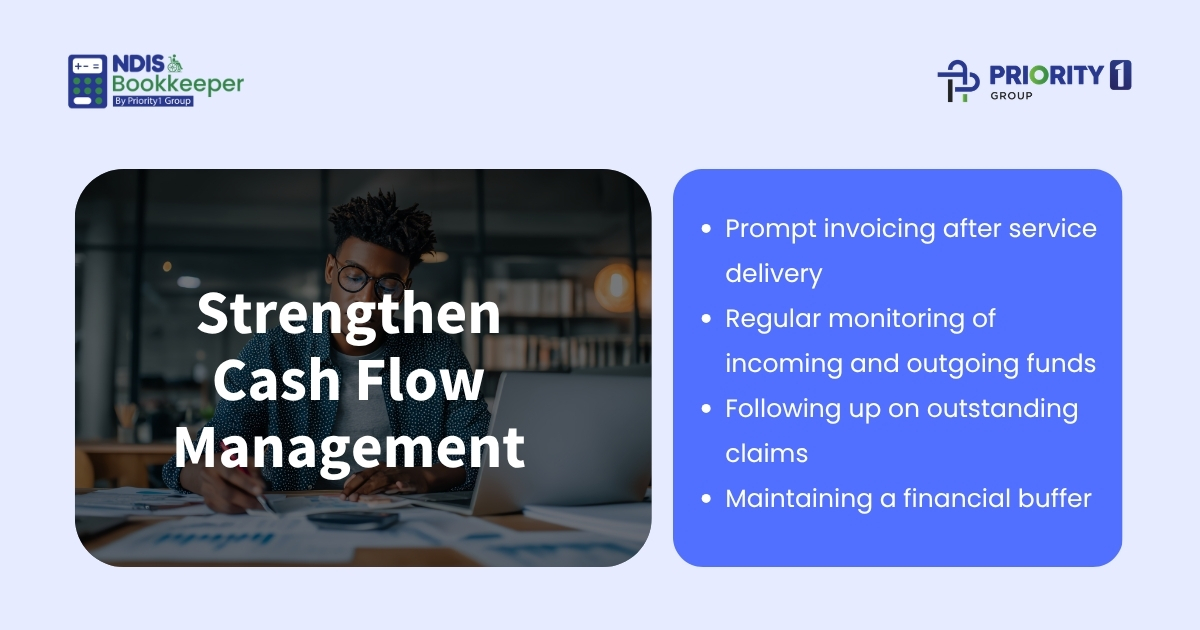
Cash flow is the lifeline of your business. Without proper management, even profitable businesses can face financial stress.
Effective cash flow management includes:
Modern NDIS providers are increasingly using integrated systems to manage their operations and finances.
These systems help:
Compliance should be built into daily operations rather than treated as a one-time task.
This means:
Being audit-ready at all times reduces stress and ensures smooth regulatory processes.
As NDIS businesses grow, managing financial operations internally can become overwhelming. This is where outsourcing becomes a strategic advantage.
Working with an outsourced bookkeeper allows providers to access specialised expertise without increasing internal workload. It ensures that financial processes are handled professionally, consistently, and in line with NDIS requirements.
Outsourcing can help providers:
If you are looking to build a strong financial foundation, this guide provides valuable insights:
Outsource Bookkeeping For Small Business: Start Clean, Stay Clean
A professional ndis bookkeeper plays a critical role in improving financial efficiency. They do not just manage records, they provide structure, insight, and control over your financial processes.
With the right expertise, providers can:
This transforms financial management from a reactive task into a strategic advantage.
The NDIS sector is evolving rapidly, and financial management practices are evolving with it.
There is an increasing focus on compliance and transparency, with providers expected to maintain accurate and detailed financial records. At the same time, businesses are becoming more data-driven, using financial insights to guide operational decisions.
Integration is another key trend. Providers are adopting systems that connect finance, HR, and operations, creating more streamlined workflows and reducing duplication.
Additionally, outsourcing is becoming more common as providers recognise the value of specialised expertise in managing complex financial requirements.
Financial efficiency is built through consistent systems, structured processes, and the right support.
When your financial systems are strong:
This creates a foundation that allows you to grow without compromising service quality or operational control.
Maximising financial efficiency in NDIS operations is essential for building a stable, compliant, and scalable business. With increasing regulatory requirements and operational complexity, having structured financial systems is no longer optional, it is critical.
Partnering with a professional NDIS Bookkeeper by Priority1 Group ensures accurate financial management and supports NDIS providers in maintaining compliance, growing their business, and providing high-quality care to participants.