Financial discrepancies can be a major headache for any business, but for NDIS providers, these discrepancies carry even higher stakes. They can lead to compliance issues, audit stress, delayed payments, and loss of funding, all of which undermine the stability of your business. The NDIS sector is complex, and managing financials in line with its regulations requires diligence and accuracy.
Handling discrepancies in NDIS finances is critical to ensuring smooth operations, maintaining compliance, and preserving cash flow. In this blog, we will discuss how financial discrepancies arise, the steps you can take to prevent them, and the importance of expert support in ensuring accuracy.
Before we discuss how to handle discrepancies, it’s crucial to identify what causes them. By understanding these common pitfalls, NDIS providers can develop systems to prevent financial errors before they occur.
A leading cause of financial discrepancies is the incorrect submission of claims and invoices. Since NDIS funding is structured across multiple categories, such as Core Supports, Capacity Building, and Capital Supports, it is essential that claims are correctly linked to the services provided. Errors in this area can lead to claims being denied, delaying payments, and ultimately affecting your business’s cash flow. This is especially problematic when payments are expected but aren’t received on time due to inaccuracies in the claims process.
Misallocating funds across various support categories or participants is another common issue. NDIS funding is typically divided between different types of supports, and each category has specific rules for what can and cannot be funded. Incorrectly allocating funds to the wrong category can cause discrepancies in both the financial reporting and future claim submissions.
Payroll is one of the largest expenses for NDIS providers, and errors in this area can lead to discrepancies. Common mistakes include miscalculating hours worked, failing to apply the right awards, and not tracking overtime or allowances correctly. These errors, though often overlooked, can lead to significant financial discrepancies that may disrupt service delivery and even violate NDIS compliance requirements.
Accurate and complete documentation is essential in the NDIS environment. Missing service agreements, inaccurate participant records, and untracked changes in participant plans can all lead to discrepancies when claims are submitted or audits are conducted. Providers may face penalties if these discrepancies are not addressed promptly.
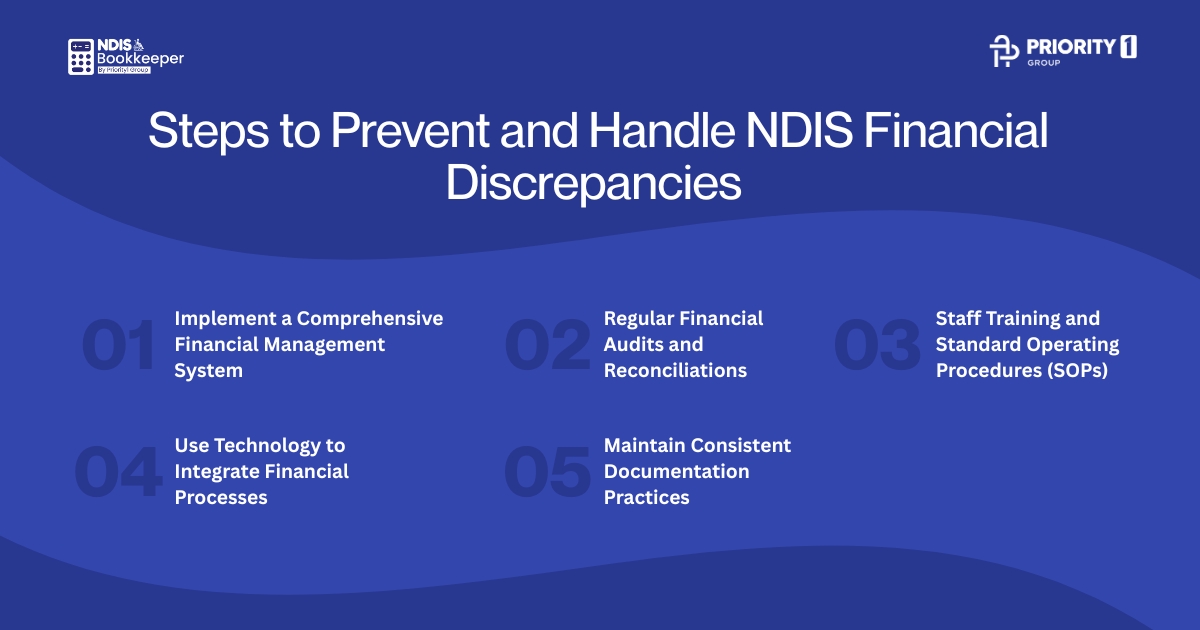
While it’s nearly impossible to avoid every discrepancy, having systems in place to identify and address errors early can make a world of difference. Below are the best practices that can help prevent financial discrepancies in NDIS operations:
While it’s nearly impossible to avoid every discrepancy, having systems in place to identify and address errors early can make a world of difference. Below are the best practices that can help prevent financial discrepancies in NDIS operations:
One of the most important steps in preventing financial discrepancies is setting up a comprehensive financial management system that ensures all transactions are tracked accurately. An organised system should integrate invoicing, claims, payroll, and participant data, making it easier to spot errors and discrepancies before they become bigger issues.
Using accounting software tailored for NDIS providers will allow you to integrate these functions seamlessly. Ensure that your system enables real-time tracking and accurate recording of participant funding, service delivery, and billing. This will allow you to stay on top of your financial processes, reducing the chance of discrepancies and errors.
For further guidance on building a strong financial system for your NDIS business, you can refer to this blog on NDIS Financial Management System.
Regular audits are an essential part of any financial management system. By regularly reviewing financial statements, invoices, and claim submissions, you can spot inconsistencies and address them before they escalate.
Conducting quarterly or monthly audits will help you ensure that your business is on track and that you haven’t missed any potential discrepancies. In addition, reconciling bank statements with your financial records helps confirm that all transactions have been properly documented. This process also allows you to identify any potential issues early, before they have a significant impact on your finances.
Proper training for your staff is essential to ensuring that errors do not occur. A well-trained team can help prevent payroll errors, misallocated funds, and incorrect claims. Developing standard operating procedures (SOPs) for financial tasks, such as invoicing and fund allocation, ensures that everyone follows the same processes and reduces the chance of mistakes.
Moreover, creating a system for your team to regularly check for errors and verify that all necessary documentation is present and accurate will further reduce the likelihood of discrepancies. Continuous staff education and standardised workflows will create a more efficient, error-free environment.
Today’s technology can make a significant difference in preventing financial discrepancies. Integrated software that connects your payroll, rostering, invoicing, and claims processes is a game-changer. Such technology streamlines operations, reduces human error, and ensures accuracy. It also ensures that every aspect of your financial operations is connected, making it easier to spot discrepancies.
For example, integrating your rostering system with payroll software ensures that the correct hours are recorded, and participants’ specific needs are tracked accordingly. Similarly, linking your claims system with invoicing can ensure that services are billed promptly and accurately, thus reducing the chances of errors or missed payments.
Accurate documentation is essential for preventing discrepancies in NDIS operations. Ensure that your business has a standard operating procedure (SOP) for documentation, and make sure all participants’ records are maintained consistently and securely. Regular audits of these documents will help identify missing or outdated records, preventing discrepancies during claim submissions.
Using digital document management systems can help you store all records securely and make them easily accessible for audits and reporting. This also ensures that all financial processes are transparent and compliant with NDIS regulations. Bookkeeping for NDIS providers becomes much more efficient when your documentation is organised, accessible, and properly maintained.
Managing NDIS financials can become increasingly complex as the business grows. One of the most effective ways to ensure accuracy and compliance is to work with an outsourced bookkeeper who specialises in NDIS financial management. An outsourced bookkeeper NDIS brings in the expertise needed to prevent and address discrepancies effectively.
An outsourced bookkeeper helps businesses by:
If you’re struggling to manage the growing financial complexity of your NDIS business, partnering with an outsourced bookkeeper can help you focus on service delivery while leaving the financial complexities to the experts. By doing so, you reduce the risk of discrepancies and improve your financial accuracy across the board.
For more details on why outsourcing bookkeeping services is a great option for small businesses, check out this insightful blog: Why Growing Businesses Outsource Bookkeeping Before It Gets Messy
Once a discrepancy is identified, it’s important to address it promptly to avoid further complications. Here’s a step-by-step process to handle existing financial discrepancies:
The first step is to determine what caused the discrepancy. Whether it’s an issue with incorrect claims, misallocated funds, or payroll errors, understanding the source of the problem is crucial for resolving it quickly.
Once the issue is identified, take immediate action to correct it. This may involve adjusting invoices, reallocating funds, or updating payroll records. Make sure to document the correction process to maintain transparency.
If the discrepancy involves participants, providers, or the NDIS, communicate with them promptly to explain the issue and provide a resolution. Open communication helps maintain trust and ensures that all parties are aligned.
To prevent the same issue from occurring in the future, implement the corrective measures identified during the resolution process. This might include improving staff training, updating financial systems, or refining workflows to prevent similar discrepancies from happening again.
Financial discrepancies in NDIS operations are inevitable, but with the right systems and procedures in place, you can handle them efficiently and minimise their impact. By implementing systematic processes for invoicing, claims management, payroll, and fund allocation, you can prevent discrepancies and ensure that your financial system runs smoothly. Regular audits, clear documentation practices, and efficient reporting are key to staying on top of potential issues.
Partnering with a professional NDIS Bookkeeper by Priority1 Group ensures that your financial management systems are both accurate and compliant. With expert support, you can focus on delivering high-quality care to your participants, knowing that your finances are in good hands. Whether you’re managing claims, payroll, or compliance, having a dedicated bookkeeper allows your NDIS business to run efficiently and with greater confidence.