

Success within the NDIS sector depends on far more than delivering quality support services. Providers must also build strong financial systems that support operational stability, compliance, staff management, participant satisfaction, and long-term growth.
As the disability services landscape continues evolving, financial management has become one of the most important factors influencing sustainability. Providers are expected to manage participant funding accurately, maintain payroll compliance, handle claims efficiently, prepare for audits, and make informed operational decisions, all while continuing to provide participant-centred care.
Without clear financial strategies, organisations often face challenges such as inconsistent cash flow, delayed claims, payroll errors, compliance risks, and operational inefficiencies. Over time, these problems can affect both service delivery and organisational growth.
Effective financial strategies help providers create structure, improve visibility, reduce risk, and strengthen long-term decision-making. More importantly, they allow organisations to focus confidently on delivering high-quality participant outcomes.
This article explores how NDIS providers can create effective financial strategies that support operational success and long-term sustainability.
Many providers focus heavily on participant care but underestimate the importance of strategic financial planning. However, financial management affects nearly every aspect of service delivery.
A strong financial strategy helps providers:
Without a structured financial approach, organisations may find themselves reacting to problems rather than proactively managing them.
Financial planning is especially important within the NDIS environment because providers operate under strict funding rules, pricing structures, and compliance obligations. Every operational decision can carry financial implications.
Financial success and participant outcomes are closely connected.
When providers maintain stable financial systems, they are generally better positioned to:
In contrast, financial instability often creates operational pressure that affects both staff and participants.
For example:
This is why financial strategy should be viewed as a core part of organisational leadership rather than simply an administrative responsibility.
Every effective financial strategy starts with strong foundational systems.
Providers should focus on creating processes that support consistency, visibility, and accountability across the organisation.
Participant Budget Management- Monitoring participant budgets carefully helps prevent overspending and service interruptions.
Payroll and Workforce Management- Accurate payroll processing supports compliance and staff satisfaction.
Claims and Revenue Tracking- Providers should regularly monitor claims, receivables, and payment cycles.
Financial Reporting- Reliable reports support better operational and strategic decisions.
Compliance Documentation- Maintaining accurate records improves audit readiness and operational transparency.
Strong foundational systems reduce administrative pressure and improve long-term sustainability.
Cash flow remains one of the biggest challenges facing many NDIS providers.
Even organisations delivering excellent participant care may struggle financially if invoicing, claims processing, or payment tracking systems are inefficient.
Providers should create proactive cash flow strategies rather than waiting for financial problems to arise.
Strong cash flow management provides greater operational confidence and allows providers to focus more effectively on participant support.
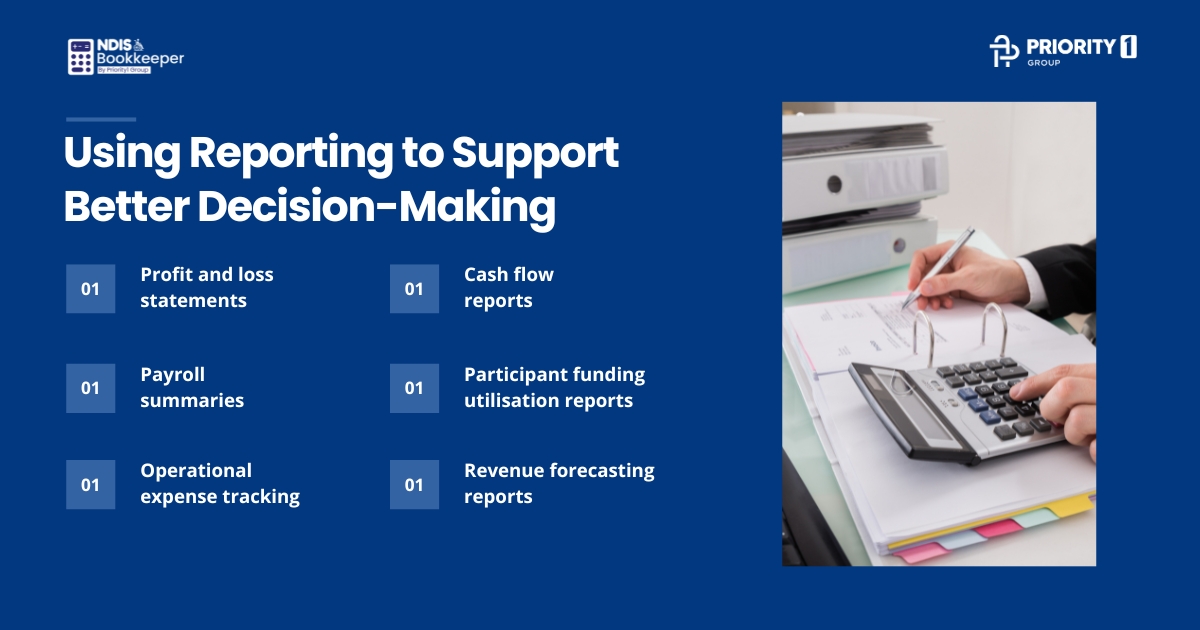
Many providers generate financial reports but fail to use them strategically.
Financial reporting should provide clear insight into the organisation’s operational performance and future planning opportunities.
Important reports may include:
These reports help leadership teams identify risks early and make informed business decisions.
Providers looking to strengthen budget planning and financial alignment may also find value in resources such as Aligning Your NDIS Budget With Service Goals, which explores how financial planning can support both operational and participant outcomes.
Financial management should not be isolated within the finance department alone.
Support coordinators, roster managers, administrators, payroll teams, and leadership staff all influence financial performance through their daily responsibilities.
Creating accountability across departments helps improve consistency and reduce operational risk.
Standardise Operational Processes- Clear procedures reduce inconsistencies and confusion.
Train Staff Regularly- Employees should understand how their actions affect financial outcomes.
Encourage Cross-Department Communication- Collaboration between operations and finance teams improves problem-solving.
Conduct Routine Reviews- Regular audits and reconciliations help identify issues early.
Monitor Key Performance Indicators- Tracking financial performance helps organisations remain proactive rather than reactive.
Financial accountability becomes much stronger when teams understand the broader operational impact of their responsibilities.
Compliance remains one of the most critical aspects of NDIS financial management.
Providers must maintain detailed records relating to:
Without proper systems, preparing for audits can become stressful and time-consuming.
Building audit-ready processes throughout the year helps reduce pressure and improve organisational confidence.
Many providers strengthen these systems by working with financial specialists such as Outsourced Bookkeeper, helping them improve operational consistency and maintain stronger financial oversight.
Providers can also gain additional insights through resources like How Outsourced Bookkeeping Makes You Audit-Ready All Year, which explains how structured financial processes support compliance readiness and operational stability.
Technology has become increasingly important for providers managing multiple participants, staff members, and operational systems.
Integrated software platforms can help providers manage:
However, technology alone is not enough. Providers must ensure systems are implemented correctly and supported by strong operational procedures.
Regular staff training and process reviews remain essential for maintaining financial accuracy.
Many growing organisations also rely on experienced professionals specialising in NDIS bookkeeping to improve system oversight and reduce administrative pressure internally.
Growth without financial planning can create serious operational challenges.
As providers expand, they often experience:
Sustainable growth requires financial strategies that support scalability.
Strong financial strategies help providers expand confidently while maintaining service quality and compliance standards.
Many organisations also work closely with an experienced NDIS bookkeeper to strengthen financial visibility and improve long-term planning during periods of growth.
Creating effective financial strategies is essential for NDIS providers who want to maintain stability, improve operational performance, and support long-term growth.
Strong financial systems allow organisations to balance participant care with operational sustainability. From cash flow management and payroll to reporting, compliance, and audit preparation, every aspect of financial management contributes to organisational success.
Providers that invest in structured processes, financial visibility, staff accountability, and strategic planning are often better equipped to manage industry changes and operational pressures.
As the NDIS sector continues evolving, organisations with strong financial foundations will remain more resilient, scalable, and participant-focused.
Partnering with NDIS Bookkeeper by Priority1 Group can help providers strengthen financial systems, improve operational efficiency, and build sustainable strategies that support long-term success in the disability services sector.