Running an NDIS business means managing more than daily services. Providers also need to keep track of invoices, claims, payroll, expenses, payments, reports, and compliance records. When these financial tasks are left too long, small issues can quietly turn into bigger problems.
Monthly finance checks help NDIS providers stay organised and prepared. They give business owners and managers a regular chance to review what has happened, what still needs attention, and what could affect cash flow in the coming weeks. For small and growing providers, this routine can reduce stress and support better decisions.
The goal is not to make finance complicated. It is to make the numbers easier to understand. When records are reviewed every month, providers can identify late invoices, payroll pressure, claim-related gaps, missing documents, and unusual changes before they become difficult to manage.
NDIS providers work in an environment where finance and operations are closely connected. A support worker’s shift may connect to a roster, a participant service, an invoice, a payment, and a payroll entry. If one part of that record is missing or delayed, the financial picture can become unclear.
A monthly finance check helps providers pause before pressure builds. It can answer important questions such as: Were all completed services invoiced? Are payments being received on time? Are staff costs increasing? Are reports showing the right information? Are there gaps that need follow-up?
This is especially important for growing providers. Growth often brings more participants, more workers, more claims, more expenses, and more admin. Without regular review, the business may look busy but still feel financially uncertain.
Income should be one of the first areas providers review each month. It is not enough to know that services were delivered. Providers also need to check whether those services were invoiced, whether payments were received, and whether anything is still outstanding.
Late invoicing can affect cash flow even when the business is busy. If services are delivered but invoices are delayed, the provider may carry wage costs and operating expenses before the income arrives. Over time, this can create pressure.
Providers should also review unpaid invoices. Some may only need a simple follow-up, while others may require checking claim details, service dates, or payment allocation. The earlier these issues are reviewed, the easier they are to manage.
Income checks are also important after pricing updates. If rates, support items, or billing processes have changed, monthly review helps confirm whether those updates are reflected properly in invoices and reports. This related article on how outsourced bookkeepers help manage NDIS pricing updates explains why pricing changes should be connected to regular bookkeeping routines, not treated as a one-time task.
A simple monthly income review can help providers catch gaps early.
These checks help providers avoid relying only on the bank balance. The bank balance may show money available today, but it does not always show what is overdue, what is expected, or what costs are coming next.
Payroll is one of the most important financial areas for NDIS providers. Support workers need to be paid correctly and on time, and providers need to understand how wages affect cash flow and business sustainability.
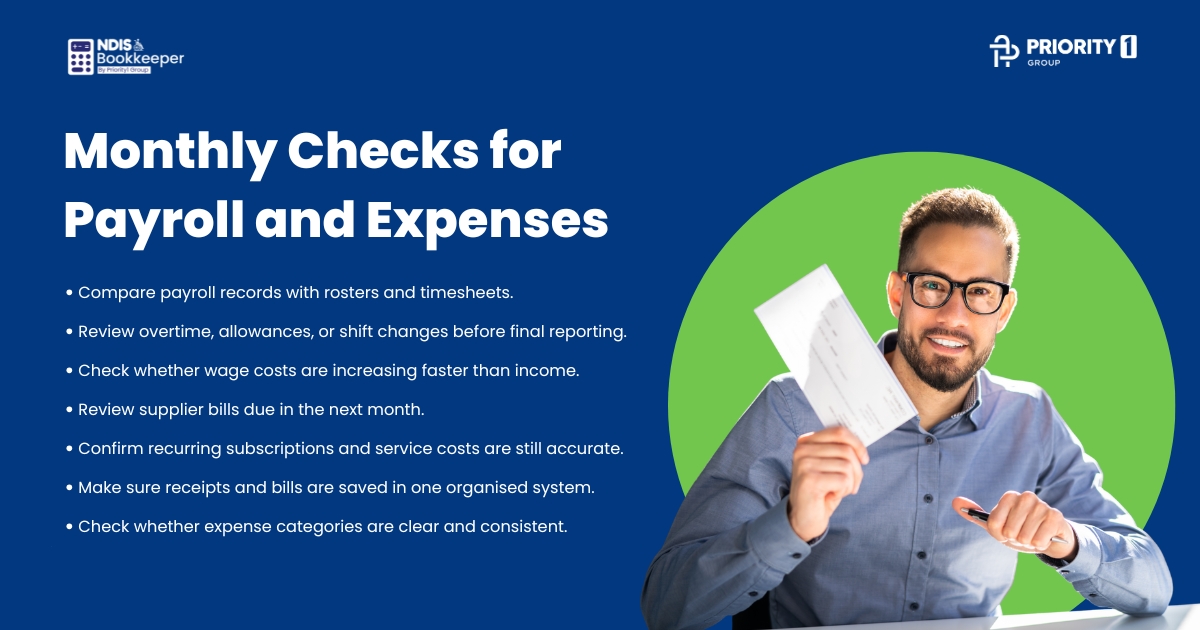
Each month, providers should check whether payroll records align with rosters, timesheets, and service delivery information. If shifts changed during the month, those changes should be reflected properly. If allowances, overtime, or varied hours apply, they should be reviewed before payroll becomes difficult to explain later.
Payroll is also closely linked to cash flow. A provider may need to pay wages before related payments are received. This is common in many service businesses, but it needs to be monitored. If payroll costs are increasing while payments are delayed, the provider needs to see that early.
This is where working with a ndis bookkeeper can help providers maintain clearer records and reduce the pressure of reviewing payroll, invoices, and reports all at once.
Expenses can slowly increase without providers noticing. Software subscriptions, training, insurance, rent, transport costs, admin support, equipment, and supplier bills can all affect the monthly position. If these costs are not reviewed, the business may not realise where money is going.
A monthly expense review helps providers understand which costs are necessary, which have changed, and which may need attention. It also helps with planning. For example, if a large supplier bill or insurance payment is due soon, the provider can prepare instead of being surprised.
Providers should also check whether expenses are categorised correctly. Clear categories make reports easier to read and help business owners understand the real cost of running services.
Payroll and operating expenses can strongly affect the financial position of an NDIS provider.
These checks reduce the stress of trying to understand costs later. They also help providers prepare better monthly reports and make more confident decisions.
Monthly reports should not be treated as paperwork that gets filed away. They should help providers understand the story behind the numbers. A useful report shows income, expenses, wages, unpaid invoices, profit trends, and cash flow pressure in a way that supports decision-making.
For example, a provider may notice that income has increased, but cash flow still feels tight. A monthly report may show that unpaid invoices have also increased, or that payroll costs have grown faster than income. Without reporting, the provider may feel the pressure without knowing what is causing it.
This is where ndis bookkeeping becomes more than record-keeping. It helps providers connect financial activity with real business decisions. If reports are reviewed regularly, providers can respond earlier instead of waiting until problems become urgent.
Financial records are only useful if the supporting documents can be found when needed. Invoices, receipts, payroll records, service-related notes, supplier bills, and payment details should be stored in a consistent system.
Many providers lose time because records are saved across emails, phones, folders, spreadsheets, and paper files. This can create stress when information is needed quickly. A monthly document check helps prevent this.
Providers should review whether documents are complete, correctly named, and stored in the right place. If something is missing, it is easier to ask for it within the same month rather than months later.
Monthly finance checks are valuable, but they can take time. For busy providers, the challenge is not knowing that checks are important. The challenge is finding the time to complete them properly every month.
This is where external support can help. Outsourced Bookkeeper shares useful insights into how bookkeeping support can reduce admin pressure for growing businesses. Providers can also read this guide on how outsourced bookkeepers save time and admin to understand how structured support can help businesses stay organised without adding more pressure to internal teams.
For NDIS providers, outsourced support can help keep monthly checks consistent. It can support reconciliations, invoice tracking, payroll record review, reporting, and document organisation.
A simple monthly review should leave providers with clearer answers, not more confusion.
If providers ask these questions every month, they can build a stronger habit of financial review. Over time, this makes the business easier to manage.
Monthly finance checks help NDIS providers stay organised, informed, and prepared. They give providers a clearer view of invoices, payments, payroll, expenses, reports, documents, and cash flow. For small and growing providers, this kind of routine can reduce stress and help prevent small gaps from becoming bigger problems.
The most important thing is consistency. Monthly checks do not need to be complicated, but they do need to happen regularly. When providers review their finances often, they can make decisions with more confidence and keep their records ready for future needs. NDIS Bookkeeping by Priority1 Group.