Running an NDIS business isn’t just about delivering quality support, it’s about proving you delivered it, invoiced it correctly, and managed the financial side in a way that stands up to scrutiny. And that’s where many providers feel the pressure.
Because NDIS finances don’t behave like “normal” small business bookkeeping.
You’re dealing with multiple funding streams, changing participant plans, service agreements, shift-based service delivery, cancellations, travel rules, short-notice changes, portal claims, remittances, reconciliations, payroll alignment, and compliance expectations, all at once. You can be doing amazing work on the floor, but if your backend is messy, it can quietly erode your cash flow, your team’s confidence, and your ability to scale.
This blog breaks down what makes NDIS bookkeeping more complex than it looks, and how to know if you’re genuinely prepared.
Many NDIS providers start with a simple setup:
That can work early on until the business grows.
Then the cracks show up in very real ways:
The challenge is that NDIS bookkeeping isn’t just recording transactions, it’s building a system that connects what happened (support delivered) to what was claimed (invoice) to what was paid (remittance) to what was actually earned (revenue), while keeping payroll, compliance, and documentation aligned.
When your backend is built for this sector properly, bookkeeping for ndis becomes less about stress and more about control.
In most NDIS businesses, the books aren’t completely wrong, they’re “mostly right”.
And that’s the danger.
“Mostly right” can still mean:
Even small errors repeated weekly can become big money over a quarter.
And when the business is busy, those errors don’t get fixed, they compound.
Supports change. Plans update. Participants cancel. Rosters shift. Worker availability changes. Travel/time rules vary. If your invoicing relies on memory or manual tracking, your billing accuracy is always at risk.
Reconciling NDIS payments can be challenging because remittances don’t always mirror your invoice layout. You need a clean method to match what you claimed to what you received and to spot what’s missing quickly.
Providers often deliver a mix of services, in-home support, community access, SIL, STA, nursing, transport, allied health coordination, and more. If your chart of accounts isn’t structured properly, your reports won’t tell you which services are driving real margin.
In NDIS businesses, payroll isn’t just an HR function, it’s your biggest cost and the key driver of profitability. If payroll (hours, rates, allowances) doesn’t align with billable supports, you can be “busy” and still lose money.
Even if you’re not being audited today, you still need to operate as if you could be asked tomorrow:
Strong books reduce stress because they reduce uncertainty.
Here’s what being prepared actually looks like in practice:
You can answer these questions quickly (without guessing)
If those questions take days (or cause anxiety), your system is likely relying on manual effort rather than structure.
For more on building a solid system, check out 10 Essential Bookkeeping Tips for Small Business Owners
You might be “getting by”, but look out for these signals:
You’re always chasing timesheets, notes, or approvals before invoicing
Invoices go out late because someone has to “double check everything”
Remittances aren’t reconciled regularly (or at all)
Your profit and loss doesn’t feel believable
You feel unsure before every BAS
You don’t have clean service-level reporting
You can’t confidently forecast cash flow
Your bookkeeper doesn’t understand NDIS claiming realities
You’re growing, but the admin load is growing faster
If any of this sounds familiar, it’s not a failure, it’s a sign the business has outgrown a basic bookkeeping approach. Outsourced bookkeeper can help you scale effectively by implementing the right systems, ensuring growth isn’t weighed down by operational inefficiencies.
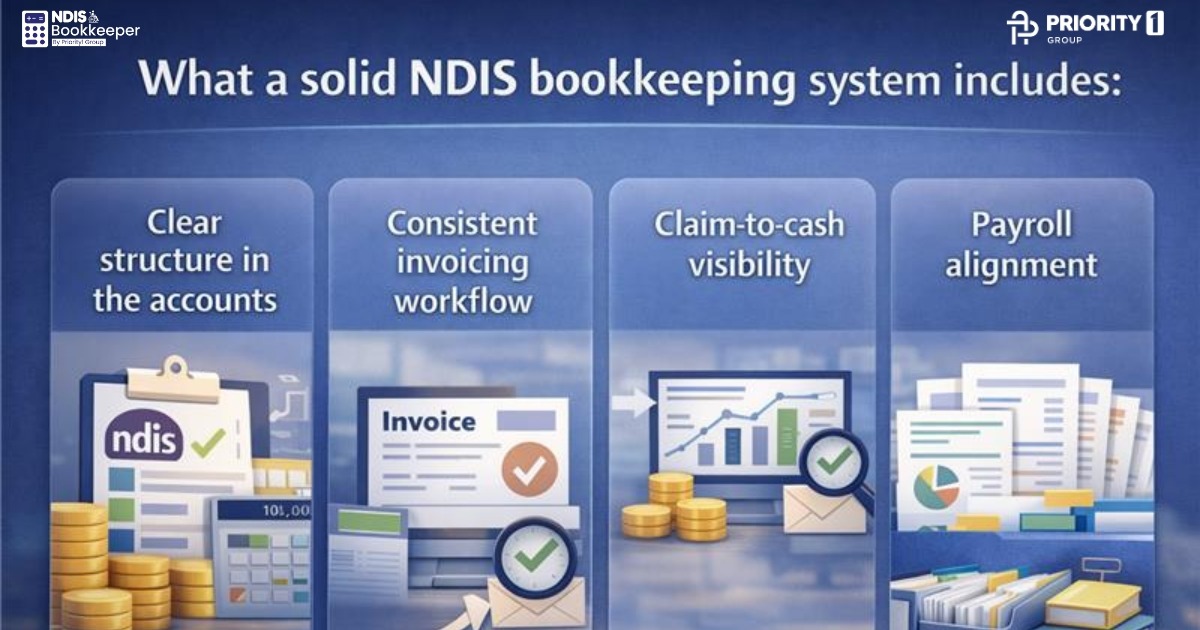
A dependable setup usually has these foundations:
Your chart of accounts needs to reflect how NDIS businesses actually operate, by service lines, funding sources (where relevant), and key cost categories. When this is done well, your reports become decision-making tools, not just compliance outputs.
Invoices should be generated from a consistent process not a scramble. That means:
You should be able to see:
A strong system connects rostering/timesheets to payroll and links payroll cost back to service lines. This is where profitability becomes clearer and cost leakage becomes visible.
This isn’t about “more paperwork.” It’s about reducing risk and reducing rework.
When your books are structured properly, you stop operating in reaction mode.
Instead, you can:
This is what good financial management looks like in the NDIS space: not just correctness, but clarity.
If you’re looking for a practical, easy-to-follow guide to simplifying financial management (without drowning in jargon), this blog is a strong next step:
NDIS Accounting Made Easy: Simplifying Financial Management for Providers
NDIS businesses are built on trust and trust is supported by strong systems.
If you’re serious about scaling, hiring more staff, adding services, or tightening your compliance position, your bookkeeping foundation matters more than ever. The earlier you systemise it, the less time you’ll spend cleaning up later.
In the middle of all this, remember: you’re not just doing bookkeeping for ndis providers you’re building financial clarity that protects participants, supports staff, and strengthens the business.
NDIS Bookkeeper by Priority1 Group, supports providers with clean, compliant, and scalable bookkeeping systems designed for real-world NDIS operations, so you can stay audit-ready, protect cash flow, and make confident decisions as you grow.