
NDIS providers sit in one of the most demanding operating environments in Australia. You are balancing participant outcomes, staffing pressures, rostering changes, funding rules, reporting timelines, and audit expectations, all at once. When the financial side is held together with spreadsheets, manual fixes, and “we’ll sort it later” processes, it rarely stays manageable for long.
Smart financial systems are not about making things complicated. They are about making the basics reliable. When the right structure is in place, your business can respond faster, report cleaner, and grow without feeling like every new participant adds chaos to the back office.
In many industries, bookkeeping errors create inconvenience. In the NDIS, errors can create real risk. Funding is controlled, supports must align with plans and service agreements, and documentation needs to stand up to scrutiny.
Common provider problems usually come back to the same root cause: systems that are not built for the way NDIS services actually run.
These issues often include:
A smart system reduces these problems by making the flow of information consistent from service delivery to invoicing to reporting.
Smart does not mean expensive software or complex dashboards. It means your core financial workflow is designed to be accurate, repeatable, and easy to explain.
A strong financial system typically includes:
When these pieces work together, your numbers stop being a guessing game.
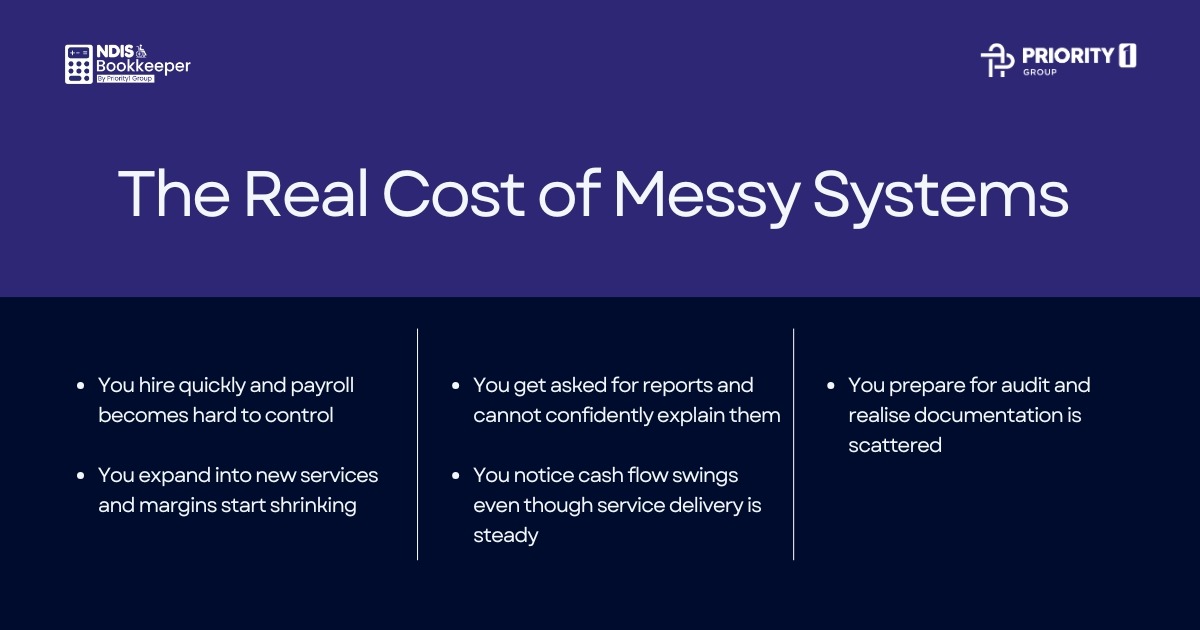
Most providers do not feel the pain immediately. The business might run fine for months. Then one of these moments hits:
By the time the problem is visible, the fix is usually more expensive because it involves cleaning months of errors and re-training the team. Smart systems prevent the build-up.
Cash flow issues in NDIS businesses are rarely caused by “lack of work.” They are usually caused by delays and mismatches.
For example: services are delivered, but claims are delayed because support notes are incomplete or the invoicing data does not match what was rostered. Or expenses hit today while claims land weeks later, and the business sits under pressure in between.
A clean system improves cash flow by:
Even simple improvements like weekly checks and clean coding can stabilise your cash position.
Payroll is one of the biggest spend areas for NDIS providers. It is also one of the fastest ways to lose trust internally if something goes wrong. Strong payroll management ensures accuracy, transparency, and control over these critical costs.
A smart payroll financial structure helps you:
Track wages by program or service stream
Separate ordinary hours, overtime, allowances, and reimbursements cleanly
Maintain accurate liabilities and payments (super, PAYG, leave accruals)
Explain payroll costs clearly when reviewing profitability
Reduce pay run errors and follow-up queries
When payroll is clean and supported by effective payroll management, managers can make better rostering decisions because the true cost is visible.
If reporting feels like a monthly panic, it usually means the process is not designed for speed and clarity.
The goal is not more reports. The goal is reports you can trust.
Smart systems allow you to produce:
When the numbers are dependable, you can make decisions faster and with more confidence.
If your finance workflow feels messy, you do not need to rebuild everything overnight. Start with the foundations.
A practical starting point includes:
Small structure changes create big long-term impact because they reduce rework.
Long-term success is not only about delivering quality supports. It is also about being stable enough to keep delivering them. Strong NDIS Bookkeeping plays a critical role in building that stability.
Smart financial systems support long-term NDIS success by:
When your systems are clean and supported by effective NDIS Bookkeeping, your business becomes more resilient.
Smart financial systems are a practical advantage for NDIS providers. They reduce admin pressure, improve visibility, and create stability that supports sustainable growth. The providers who thrive long-term are not always the busiest. They are the ones who can clearly track performance, manage risk, and make decisions based on reliable numbers.
If you want support building stronger systems and reducing the financial noise that holds teams back, Priority1 Group can help you design a structure that fits the realities of NDIS operations and scales with your growth. Work with an ndis bookkeeper who understands funding, compliance and reporting.